AI Tools in Poker: What They Do
AI now sits inside solvers, trainers, and trackers — and inside bots. What the legitimate AI poker tools do and where the cheating line is.
On this page · 5 sections
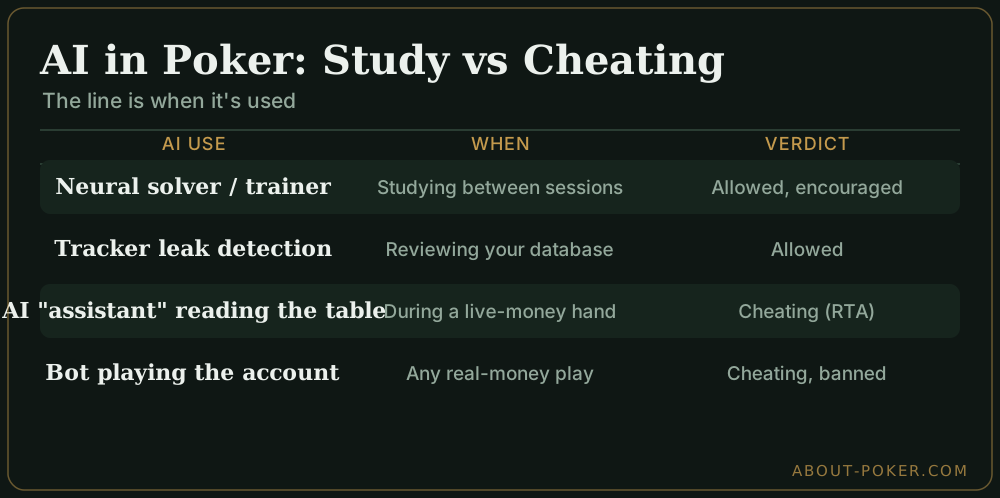
The best AI tools for poker are the ones you use between sessions to study. Everything else is a ban risk. That single test — before a hand or during it — sorts the entire landscape more reliably than any brand list:
| AI use | When | Verdict |
|---|---|---|
| Neural solver / trainer | Studying between sessions | Allowed, encouraged |
| Tracker leak detection | Reviewing your database | Allowed |
| AI “assistant” reading the table | During a live-money hand | Cheating (RTA) |
| Bot playing the account | Any real-money play | Cheating, banned |
The top two rows build a skill you keep. The bottom two rent an answer you didn’t earn — and rooms treat those as fraud, with permanent bans and confiscated balances. Once that line is clear, the useful question isn’t “is this AI tool good or bad?” but “when is it used?”
The legitimate AI toolkit
Three kinds of AI tool are standard equipment for serious study, and none of them touch a live hand.
Neural solvers. Traditional solvers grind out strategy with math (CFR algorithms) — exact, but slow and memory-hungry. AI solvers instead train a neural network to approximate the answer, trading a sliver of precision for enormous speed. That speed is what makes it practical to explore preflop GTO ranges and whole game trees a pure math solver would choke on.
GTO trainers. These drill you against solver-derived strategy and score each decision, using AI to generate spots and grade your play in real time — real time in training, not in a live game. They turn passive solver output into active reps.
AI inside trackers. Modern tracking software increasingly layers pattern detection on top of your database — surfacing leaks automatically, clustering opponents by playing style, flagging spots where you deviate from a baseline. It’s analysis you’d otherwise do by hand, done faster.
The tools people actually use
Names help. The table below maps the three legitimate categories to the best-known products in each, what they’re for, and rough pricing — this space moves fast, so treat prices as ballpark and check the vendor before buying.
| Tool | Category | What it does | Rough price |
|---|---|---|---|
| GTO Wizard | Neural solver + trainer | Cloud solves plus drilling against them; the popular all-in-one starting point | ~$40–130/mo by tier |
| PioSOLVER | Desktop solver | The precision postflop standard; you build and run trees locally | ~$250–1,100 one-time by edition |
| Simple Postflop | Desktop/cloud solver | Postflop solving with a gentler learning curve than Pio | ~$100–475 by license |
| DTO Poker | GTO trainer | Mobile-friendly spot drills scored against solver output | Free tier; ~$15–25/mo paid |
| PokerTracker 4 | Tracker | Logs your database, HUD stats, and leak-finding reports | ~$60–100 one-time |
| Hold’em Manager 3 | Tracker | The main HM tracker/HUD alternative to PT4 | ~$60–100 one-time |
If you’re picking one to start, most studying players reach for GTO Wizard — a single subscription covers solving and trainer reps, which is where beginners get the most return. Move to a desktop solver like PioSOLVER or Simple Postflop once you want to build custom trees at solver-grade precision, and add a tracker (PokerTracker 4 or Hold’em Manager 3 — they’re close enough that it’s largely preference) once you have a database worth mining. “Best” is genuinely contested here and depends on stakes, format, and budget; the categories matter more than any single brand.
The dark side, and why it shapes the rules
No honest overview can skip the illegitimate AI, because it’s real and it drives how the rules work. Bots play hands autonomously, often across many accounts, to grind small edges at scale. Real-time assistants stop short of playing for you but feed you an AI-computed action mid-hand. Both are cheating under every major room’s rules.
They matter to honest players for two reasons. They’re the threat your room’s security is built to stop — and they’re the reason the study/play line is enforced so harshly. The software that makes bots possible is a close cousin of the solvers you study with, so rooms can’t ban the tool itself; they police the timing of use instead.
AI sits on both sides of the table
The plot twist is that rooms fight AI with AI. Modern poker-site security leans on machine learning to flag:
- decision accuracy that’s too good to be human over a large sample,
- timing patterns that match “input the spot, read the output,”
- coordinated behavior across supposedly independent accounts.
So AI is now a study partner for you and a detection engine for the site watching for anyone who crosses the line.
Studying with AI without wasting it
Owning AI tools and improving with them are different things. A few habits separate players who get better from those who just accumulate solves:
- Ask a question first. Don’t grind random trainer spots. Pick a leak you suspect — over-folding the big blind, say — and drill only that until the pattern sticks.
- Learn the why, not the click. A neural solver might check-raise a board 30% of the time; the value is understanding the range and equity reasons, so you can apply it to the next board it never showed you.
- Convert output into reps. Solver strategy read once is forgotten by the next session. Feed it into a trainer and drill it until it’s a reflex.
- Trust trends over single spots. A one-session dip means nothing; a pattern across thousands of hands is a real leak worth fixing.
AI in poker is neither a magic edge nor inherently shady — it’s a set of study tools separated from a set of cheats entirely by when they’re used. Lean hard on the study side; it’s the fastest way to internalize solver strategy and turn a database into insight. Start with how AI solvers differ from math solvers, stay crystal clear on the RTA line, and see the full kit in the tools and software hub.