What Is Donk Bet Percentage in Poker?
Donk bet percentage tracks how often a player leads into the preflop raiser out of position. Learn what the stat reveals and how to respond to donk bettors.
On this page · 6 sections
Donk bet percentage is the HUD stat that measures how often a player leads out on the flop into the preflop raiser instead of checking to them. The term “donk bet” comes from “donkey,” because leading into the player who showed strength preflop was historically seen as a beginner move. The stat has real diagnostic value: most competent players almost never donk, so a high donk bet number is a bright flag that you are up against an unconventional or exploitable opponent.
What the stat measures
Donk bet percentage counts the times a non-aggressor bet into the preflop raiser on the flop, divided by the times they had the chance to do so as the out-of-position caller, times 100. The key condition is that the player calling preflop is first to act on the flop and chooses to bet rather than check. If they check, or if they were the preflop raiser, it is not a donk bet.
This stat belongs to the postflop family covered in our advanced HUD stats: steal and postflop breakdown. It pairs naturally with fold-to-c-bet, because a player who donks a lot is refusing to give the raiser the standard chance to continuation bet.
What a normal donk bet number looks like
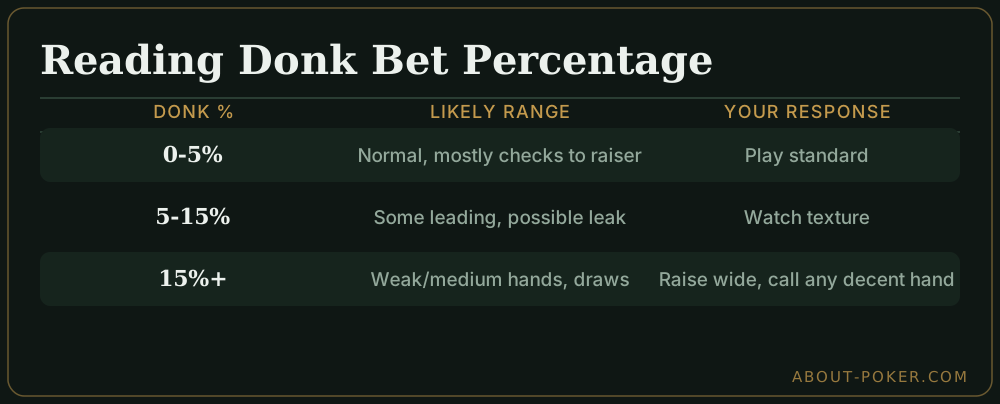
- 0 to 5 percent: normal. Solid players donk rarely because checking to the raiser and check-raising or check-calling is usually stronger.
- 5 to 15 percent: slightly elevated. The player may have a specific leading strategy on certain textures, or may be leaking.
- Over 15 percent: a habitual donk bettor. This is an exploitable pattern, and it usually means the player leads with weak-to-medium hands, draws, or a misguided “protect my hand” instinct.
A worked example
You raise A-K from the cutoff and the big blind calls. The flop is 9-7-2 rainbow. The big blind, whose HUD shows a 22 percent donk bet, leads out for half the pot. What does that mean? A 22 percent donk range on a low, dry board is overwhelmingly weak: middle pairs like 9x, small pairs, gutshots, and the occasional pair-plus-nothing that is scared to check. It rarely contains sets, because a strong player would trap by checking to you.
Against that read, folding A-K high would be far too tight. You can call and hope to improve, but the stronger line is often to raise. Raising folds out their air and their weak pairs, and you have two overcards plus a backdoor draw for the times you get called. The donk bet, far from showing strength, has advertised weakness you can attack.
How to exploit donk bettors
The general rule against frequent donk bettors is to be aggressive. Raise their donk bets wide, both for thin value with top pair and as a bluff with equity, because their leading range folds far too often. Call comfortably with any reasonable made hand or draw, since you are usually ahead of or drawing live against their range. The flip side is the tell in reverse: when a chronic donk bettor suddenly checks to you, that check is frequently their strong hands, so a check from them should slow you down more than their bet does. This kind of frequency-based read is exactly what the poker HUD stats explained framework is built for.
Common mistakes
The first mistake is treating every donk bet as strength and folding good hands. On low, dry boards especially, the donk range is mostly weak. The second is ignoring board texture. A donk into a wet, coordinated board carries more genuine draws and made hands than a donk into a dry ace-high or low board, so calibrate your aggression to the texture. The third is trusting the stat on a small sample; donk bet opportunities are relatively rare, so it takes many flops before the number stabilizes.
Quick checklist
- Confirm a real sample; donk opportunities accumulate slowly.
- Under 5 percent is normal; over 15 percent flags an exploitable pattern.
- On dry boards, most donks are weak, so raise them wide.
- On wet boards, respect donks more; they hold more real equity.
- Note when a habitual donker checks; that check is often their strong hands.
Read alongside the rest of your layout as explained in how to read and use a poker HUD, donk bet percentage flags the players who hand you information for free, then lets you punish them for it.
Frequently asked
What is a donk bet in poker?
A donk bet is when a player who is not the preflop aggressor leads out into the raiser on the flop instead of checking to them. It goes against the usual flow where the preflop raiser gets to continuation bet first, which is why it is often a sign of a weaker player or a specific plan.
What is a normal donk bet percentage?
Most solid players donk bet close to zero percent, because leading into the raiser is rarely optimal. A donk bet above roughly 15 percent flags a player who leads out of turn frequently, usually with weak or medium-strength hands.
How should I play against a frequent donk bettor?
Because most donk bets are weak, you can raise them wide for value and as a bluff, and call with any reasonable hand. When a habitual donk bettor suddenly checks to you, that check is often stronger than their bet, so proceed with more caution.