What Is WTSD in Poker?
WTSD (Went To Showdown) is the percentage of hands a player shows down after seeing the flop. Learn how to read it, what a good WTSD is, and how to exploit it.
On this page · 6 sections
WTSD stands for “Went To Showdown.” It is a HUD stat that tells you what percentage of the time a player, having seen a flop, ends up showing their cards at the end of the hand. It is one of the cleanest reads on how sticky an opponent is — whether they call down to the river or bail early — and it pairs directly with won-at-showdown to profile their whole postflop game.
What WTSD actually measures
WTSD is conditional on seeing the flop. Out of every hand where a player took a flop, WTSD tells you how many of those hands they carried all the way to showdown. A high WTSD means a player is hard to push off hands — they call down. A low WTSD means they fold to pressure and give up pots without showing. It says nothing about hands folded before the flop; it is a pure postflop stickiness read. For the full stat family, see poker HUD stats explained.
How to calculate WTSD
The formula is:
WTSD = (hands reaching showdown ÷ hands that saw the flop) × 100
If a player saw 200 flops and reached showdown in 54 of them, their WTSD is 54 ÷ 200 = 0.27, or 27 percent. Note the denominator is flops seen, not total hands dealt — a player who folds 80 percent of hands preflop can still have a perfectly normal WTSD.
What is a good WTSD
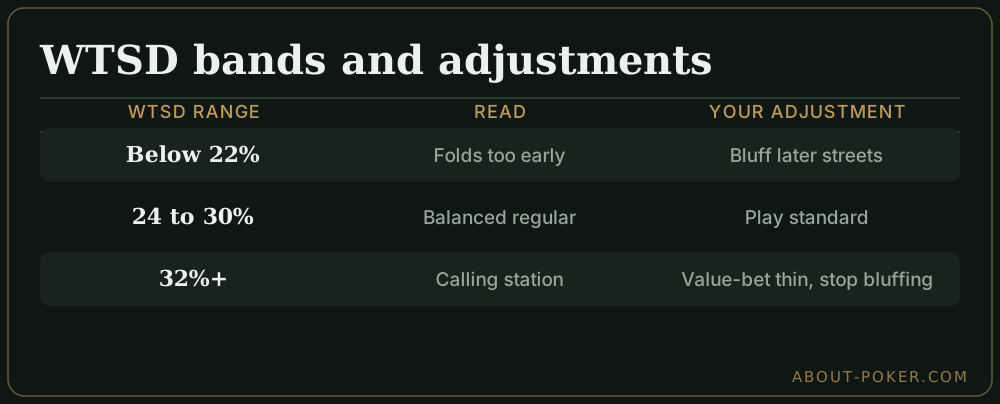
For six-max no-limit cash, these are the practical bands:
- Below 22 percent — the player folds too much before showdown. You can bluff them profitably on later streets.
- 24 to 30 percent — standard, well-balanced. This is where solid regulars live.
- 32 percent and up — a calling station. They reach showdown too often, which means they call with too many weak hands.
Higher WTSD is not automatically bad if the player also wins a lot at showdown; that combination just means they see many cheap showdowns. The danger sign is high WTSD paired with low won-at-showdown, which means they pay off value bets with hands that lose.
A worked example
You are on the river against a player whose HUD reads WTSD 34 over 600 hands. Board: Qs 8h 3d 5c 5s. You hold Ac Qh — top pair, top kicker. You bet the flop and turn and were called both times. Facing a WTSD of 34, this player is a station: they will call the river with worse queens, pocket pairs like 99 or TT, and even ace-high sometimes.
The correct play is a clear value bet, and a large one. Against a station, thin value is where you make money — a smaller “safe” bet leaves chips on the table because they were going to call a bigger size anyway. What you should not do here is turn top pair into a bluff or check for pot control; against a high-WTSD opponent, bluffing is a losing strategy and your top pair is a value hand.
Common mistakes reading WTSD
The most common error is treating WTSD in isolation. It must be read against won-at-showdown to be useful — 30/55 (WTSD/W$SD) is a solid player, while 34/42 is a losing station. See what is won at showdown in poker for the other half of the read.
The second mistake is trusting WTSD on a tiny sample. Showdown stats stabilize slowly because a single big hand can swing them; wait for at least 300 to 500 hands before leaning on the number. Finally, remember WTSD is a tendency, not a guarantee — a station can still fold occasionally, so keep betting for value rather than assuming a call every time.
A subtler error is ignoring position and street when you read WTSD. A player might call down loosely in position but fold readily out of position, so a single blended number hides useful texture. If your tracker lets you filter WTSD by position, do it — the difference between a 30 percent in-position figure and a 22 percent out-of-position figure changes how aggressively you barrel each spot.
Quick checklist for using WTSD
- Require a 300+ hand sample before trusting it.
- Below 22: bluff more, they fold before showdown.
- 24 to 30: standard, play balanced.
- 32+: value-bet thin and stop bluffing.
- Always read WTSD alongside won-at-showdown, never alone.
- High WTSD plus low W$SD is the classic losing calling station.
Used together with won-at-showdown and aggression stats, WTSD lets you know before you even act whether your opponent is the kind of player you get value from or the kind you have to run over.
Frequently asked
What is a good WTSD in poker?
For a solid six-max cash regular, a WTSD between 24 and 30 percent is standard. Below 22 percent suggests a player folds too much before showdown; above 32 percent suggests they call down too loosely and can be value-bet thin.
How is WTSD calculated?
WTSD = (hands that reached showdown ÷ hands that saw the flop) × 100. It only counts hands where the player saw a flop, not hands folded preflop.
What is the difference between WTSD and WWSF?
WTSD measures how often a player reaches showdown, while WWSF (Won When Saw Flop) measures how often they win a pot after seeing the flop, including hands taken down without a showdown by betting. They describe different parts of postflop play.