Laddering Up the Payouts
How to ladder up the payouts in tournaments: use ICM and pay-jump math to survive into bigger prizes without spewing chips or folding into oblivion.
On this page · 6 sections
Laddering means climbing the payout tiers by surviving past other players, one pay jump at a time. Every time someone busts above you, your locked prize increases, so simply not busting can be worth a meaningful amount of money. It is one of the few situations in poker where folding a hand you would normally play is provably correct.
The math behind it is the Independent Chip Model. Deep in a tournament, the chips you can lose are worth more than the chips you can win, because busting drops you to a fixed payout while winning rarely lets you climb a full tier. That asymmetry is why pay-jump strategy matters most near the top.
What laddering actually is
Payouts in a tournament rise steeply as you approach the final table. The difference between 9th and 6th might be small, but the gap between 3rd and 1st can be several buy-ins. Laddering is the deliberate act of surviving into those higher rungs by letting other players take the risks and bust first.
You do not have to play a single hand to ladder — if another player is all-in and at risk while you sit on the sidelines, their elimination pushes you up the ladder for free. Recognizing these spots and staying out of the way is a genuine skill.
When laddering is worth it
Laddering pays off when three things line up: the next pay jump is large, someone else is genuinely likely to bust soon, and calling would put your own tournament life at risk for only a small edge. In those spots, ICM says your survival is worth more than the chips in the pot.
A classic example: you are one of three short stacks on a five-handed final table, all close in size, with big jumps between each finish. Passing up a marginal shove-call keeps you alive while the other two shorts battle. If one busts, you have laddered up without risking anything — the essence of chip accumulation vs survival when survival wins.
A worked laddering example
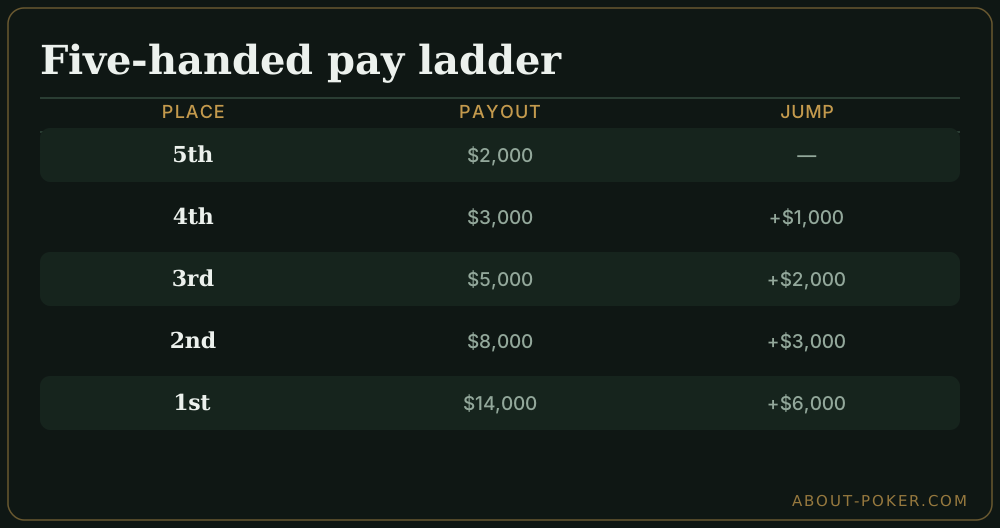
Five players remain. Payouts: 5th $2,000, 4th $3,000, 3rd $5,000, 2nd $8,000, 1st $14,000. You have 8 big blinds; two other short stacks have 6 and 5 big blinds. The two big stacks are battling in a large pot, and one short stack is about to be blinded all-in next hand.
You are dealt A9 offsuit and it folds to you. Normally an 8 BB stack shoves A9 without thinking. But here, the 5 BB player will likely be forced in next hand. If they bust, you jump from $2,000 to $3,000 for free — a 50% raise on your locked money.
Shoving A9 risks your $2,000 min-cash and your ladder position for a marginal steal. Folding, letting the shortest stack take the fall, and pocketing the pay jump is the higher-EV play. That $1,000 is more valuable than the blinds you would win.
Laddering versus playing to win
Here is the trap: laddering is a survival tool, not a path to first place. If you fold your way to the final three with 4 big blinds, you have laddered efficiently but destroyed your shot at the top prizes where the real money sits. As covered in laddering and pay jumps, the goal is to balance survival with accumulation.
Big stacks should almost never ladder passively — they should be pressuring the shorts who are trying to ladder, printing chips off their caution. Laddering is primarily a short and medium-stack tool.
Common laddering mistakes
- Over-folding into a stack too short to win, trading top-prize equity for tiny pay jumps.
- Laddering with a big stack when you should be attacking the players trying to ladder.
- Ignoring the size of the jump — laddering for $200 while risking a shot at $14,000 is backwards.
- Forgetting that once a bust happens, ICM pressure resets and you may need to re-open your game.
Laddering checklist
Before you fold to ladder, confirm the next jump is large, another player is genuinely at risk, and your survival edge outweighs the chips in the pot. Count the stacks shorter than you, watch for forced all-ins, and never ladder yourself into a stack that cannot win. Survive with a purpose, then attack once the pressure lifts.
Frequently asked
What does laddering mean in poker tournaments?
Laddering means surviving past other players to climb into higher payout tiers, one pay jump at a time. Each elimination above you moves you up the ladder and increases your locked prize, so folding to reach the next rung can be worth real money.
When should I fold to ladder up?
Fold to ladder when the next pay jump is large, another player is at serious risk of busting, and calling would risk your own tournament life for a marginal edge. ICM makes survival worth more than chips in these spots, so passing up thin gambles is correct.
Does laddering ever cost you money?
Yes. Over-foldng to ladder can leave you with a short stack that has no shot at the top prizes, where the real money is. Laddering is a short-stack survival tool, not a winning strategy — you still need chips to win the tournament.