Open-Shoving Ranges
Open-shoving ranges tell you which hands to jam first-in by stack size and position. Here's how to read the charts and shove correctly under pressure.
On this page · 6 sections
Open-shoving ranges are the short-stack player’s most important cheat sheet. When your stack is short and the action folds to you, these ranges tell you exactly which hands to move all-in with. Get them right and you accumulate blinds and antes while dodging tough postflop spots. Get them wrong and you either bust with junk or blind away a stack you could have kept alive.
What an open-shove actually is
An open-shove is moving all-in when you are the first player to enter the pot voluntarily — everyone before you has folded. It is distinct from a re-shove (jamming over someone else’s open) and from a call. Open-shoving becomes correct when your stack is too short to open-raise-and-fold profitably: at 10bb, a normal raise commits you anyway, so jamming is cleaner. The theory behind this — fold equity, M-ratio, and why shoving beats raising short — is covered in the short-stack push-fold strategy guide.
The two variables: stack and position
Every open-shove chart is organized around two inputs.
Stack depth. The shorter you are, the wider you shove, because your risk relative to the reward (the blinds and antes) shrinks. At 5bb you jam a huge range; at 15bb you shove only strong hands, because you still have fold equity in reserve and better alternatives.
Position. This is the bigger driver. Under the gun, everyone is still to act, so your shove must survive many potential wake-ups — you jam tight. On the button, only the two blinds remain, so you jam wide. In the small blind against a lone big blind, you shove an enormous range.
Reading the ranges by position
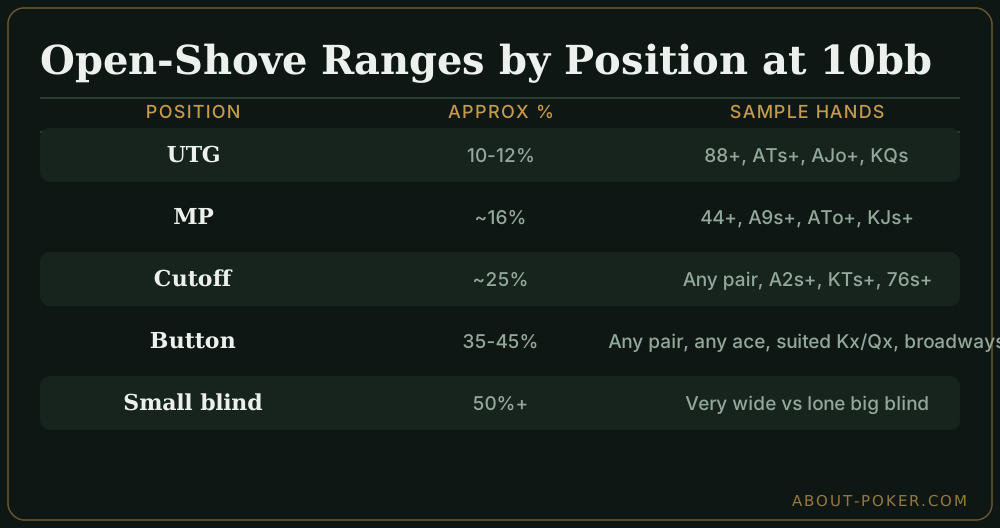
Here is the shape of a typical open-shove range at around 10bb with antes:
- Under the gun (full ring): roughly the top 10–12% — big pairs, strong aces (ATs+, AJo+), KQs.
- Middle position: widen to pairs down to 44, more suited aces, and suited broadways.
- Cutoff: any pair, most aces, suited kings and queens, suited connectors — around 25%.
- Button: any pair, any ace, most suited two-gappers, most offsuit broadways — roughly 35–45%.
- Small blind: with only the big blind behind, shove close to 50%+ of hands.
These frequencies are grounded in Nash equilibrium solutions; see Nash equilibrium shoving for how the math derives them. In practice, deviate wider against players who fold too much and tighter against stations who call everything.
A worked example
You are in the cutoff with 9bb and antes, holding 8s 7s. Two folds. Is this a shove? Suited connectors like 87s sit comfortably in a cutoff open-shove range at this depth. The reasons: you have decent fold equity (three players left, and they must risk chips to call a jam), and when called you are rarely a huge underdog — 87s runs at roughly 33–38% against most calling hands, and it flops straights and flushes that scoop pots.
Contrast that with 8s 7s under the gun at the same depth: now five players can wake up behind you, your fold equity collapses, and the hand becomes a clear fold. Same cards, opposite decision — that is the power of position in open-shove ranges.
Common mistakes
- Using one range for every seat. The single biggest error. A button range under the gun is suicide; an under-the-gun range on the button leaves money on the table.
- Shoving too tight from late position. Waiting for premiums lets the blinds print off you.
- Ignoring antes. Antes fatten the pot you are stealing, which justifies wider shoves. More antes, wider range.
- Forgetting ICM. Near the bubble or a pay jump, tighten from the raw charts because busting costs real equity.
Checklist for open-shoving
- Confirm you are first-in and short enough (roughly 15bb or fewer).
- Pick your range by position first, then adjust for stack depth.
- Widen with more antes in the pot; widen further against tight blinds.
- Tighten under ICM pressure.
- Remember it is open-shove, not re-shove — the re-steal zone guide covers jamming over opens.
Internalize these ranges and short-stack play becomes fast, confident, and profitable. Bookmark this alongside the push-fold strategy guide for the full picture.
Frequently asked
What is an open-shoving range?
An open-shoving range is the set of hands you move all-in with when the action folds to you and you are first into the pot. It applies when your stack is short enough — usually 15 big blinds or fewer — that jamming is better than making a standard open-raise.
How do open-shove ranges change with position?
They widen dramatically as you get closer to the button. Under the gun you shove tight because many players can wake up behind you; on the button and in the small blind you shove very wide because few or no players are left to call.
At what stack size do I use open-shoving ranges?
Open-shove charts kick in around 12–15 big blinds and become the default under 10. Above roughly 15bb you generally open-raise instead, keeping the option to fold to a re-raise; below it, open-jamming captures more fold equity and avoids awkward postflop spots.