Playing 40 Big Blinds in an MTT
40 big blinds is the sweet spot of tournament poker — deep enough to play real postflop but shallow enough to threaten stacks. Here's how to play it.
On this page · 6 sections
Forty big blinds is the stack depth where tournament poker is most fun and, for a lot of players, most profitable. You are deep enough to make real postflop decisions — 3-bet pots, floats, turn barrels — but shallow enough that stack-off threats are always looming. Master 40bb and you have mastered the depth you will sit at for large stretches of nearly every tournament you play.
Why 40bb is the comfort zone
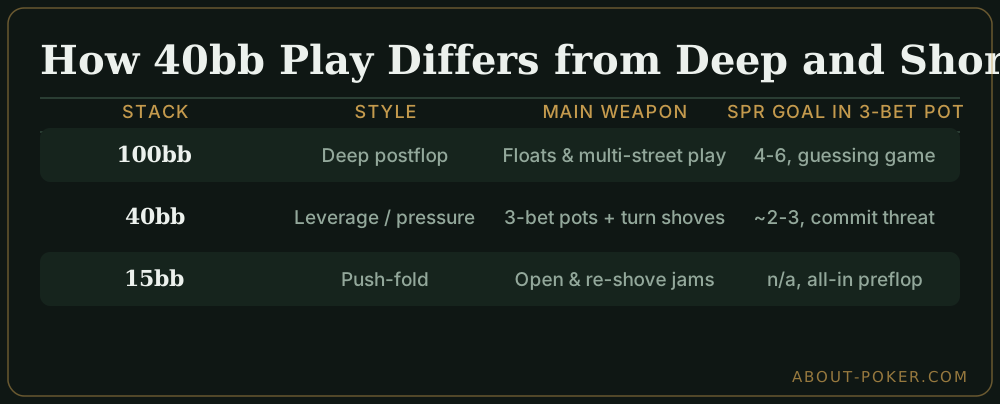
At 100bb you can lose a big pot and still have a workable stack. At 15bb you are effectively in push-fold mode and can only threaten to double, not to grind. Forty big blinds sits between those worlds. A pot-sized 3-bet still leaves plenty behind for postflop play, yet the effective stack is small enough that getting it all in on the turn is a realistic, credible threat on many boards.
This creates leverage. When you 3-bet to 9bb at 40bb deep, your opponent knows that continuing means committing toward a full stack-off. That pressure lets you play a more aggressive, well-balanced game than you can at either extreme. If you want the broader map of how ranges shift with depth, the stack depth adjustments guide lays out every band.
Opening ranges at 40 big blinds
Your raise-first-in ranges look close to a standard deep-stack chart, tightened slightly for tournament ICM. Open to roughly 2.2–2.5bb. From early position, stick to premiums, strong broadways, and pairs — think roughly the top 12–14% of hands. From the cutoff and button, widen substantially: any pair, suited aces, suited connectors, and most offsuit broadways are all fine. On the button you can open close to half your hands when the blinds are not fighting back hard.
The key discipline is folding trouble hands out of position. Offsuit gappers and weak aces that look playable at 100bb quietly bleed chips at 40bb, because you will too often be committed with a marginal holding.
Playing 3-bet pots
This is where 40bb comes alive. When you 3-bet, your sizing should leave a stack-to-pot ratio (SPR) around 2 to 3 on the flop — perfect for putting maximum pressure on one-pair hands. As the 3-bettor, you get to c-bet a wide range and often set up a turn shove that puts your opponent to a decision for their tournament.
Balance matters. A strong 3-betting range at this depth blends premiums (QQ+, AK) with bluffs that flop well — suited wheel aces like A5s, and suited connectors. Reference the 3-bet and 4-bet strategy guide for the full construction. As the caller of a 3-bet, tighten up: with an SPR near 3 you want hands that flop top pairs and sets, not speculative junk that whiffs and folds.
A worked example
You are on the button with 40bb. The cutoff, also 40bb, opens to 2.3bb. You look down at Ac Qh and 3-bet to 6.5bb. The blinds fold, the cutoff calls, and the pot is roughly 15bb with 33.5bb behind — an SPR of about 2.2.
The flop comes Qd 8c 4h. You have top pair, top kicker on a dry board. You c-bet 5bb. When called, the turn brings a 2s. Now you can bet around 12bb, a size that sets up a river that is effectively all-in. Because the SPR was low from the start, your top pair is comfortably stacking off against worse queens, flush draws, and stubborn pairs — exactly the leverage 40bb was built to apply.
Common mistakes
- Playing it like 100bb. Flatting too wide out of position and calling 3-bets with speculative hands wastes the depth. At 40bb you cannot profitably set-mine as loosely, because implied odds are capped.
- Playing it like 15bb. Some players panic and start jamming or over-folding. There is no reason to shove 40bb outside of severe ICM; you are giving up your postflop edge for no reason.
- Ignoring SPR. If you 3-bet tiny and create an SPR of 5, you have turned a leverage stack into a guessing game. Size your 3-bets to reach an SPR near 2–3.
Checklist for 40bb play
- Open around 2.2–2.5bb; tighten early, widen late.
- 3-bet to create a flop SPR of roughly 2–3, blending value and suited bluffs.
- As the 3-bet caller, favor hands that flop pairs and sets over speculative hands.
- Look for spots to set up a turn shove rather than a river guess.
- Save preflop all-ins for 4-bet jams and blind re-shoves, not open-shoves.
Play 40bb with this leverage-first mindset and you convert the most common tournament depth into a genuine edge. For a wider look at the neighboring band, pair this with playing a medium stack.
Frequently asked
Is 40 big blinds a good stack in a tournament?
Yes — 40bb is one of the most comfortable and profitable stack depths in an MTT. You have room to 3-bet, 4-bet, float flops, and apply pressure, while still being shallow enough that a single big pot can double you up or knock out an opponent.
How should my 3-bet sizing change at 40 big blinds?
At 40bb you can 3-bet to around 3x the open in position and 3.5–4x out of position, keeping some fold equity while leaving a stack-to-pot ratio that supports both value and bluffs. You are not yet forced into 3-bet-or-fold like you are at 20bb.
Should I be shoving at 40 big blinds?
Rarely. 40bb is far too deep for open-shoving except in extreme ICM spots. Preflop all-ins here come mainly as 4-bet jams over a 3-bet, or occasionally as a re-shove over a small open when action folds to you in the blinds.