Playing After the Money Bubble Bursts
Playing after the money bubble bursts: exploit the flood of short-stack all-ins, shift from survival to accumulation, and set up for the real pay jumps ahead.
On this page · 5 sections
Playing after the money bubble bursts is a distinct and highly profitable phase that many players handle poorly. For most of the bubble, everyone folds to survive; the instant the bubble breaks, that tension releases and the table dynamic flips. Short stacks who were hoarding chips start jamming any two cards, and the players who recognize this shift — moving from survival back to accumulation — clean up.
The mistake is to keep playing bubble-tight after the bubble is gone. The pressure that justified folding marginal hands has largely lifted, at least until the next meaningful pay jump. If you stay passive, you miss the softest, most action-heavy window of the money stage.
Why the field explodes right after the bubble
On the bubble, ICM pressure is at its peak and short stacks fold almost everything to sneak into the money. The moment the last non-cashing player busts, all of that suppressed aggression comes out at once. Those short stacks now think, correctly, that a min-cash is barely more than their buy-in, so they jam wide to double up or bust trying.
The result is a flood of all-ins. Short stacks shove into each other, run into the pairs and big aces of players who called, and eliminate themselves in bunches. This is why fields thin dramatically in the first few orbits after the bubble — and why you want to be the one collecting those chips rather than one of the desperate jammers. It is the mirror image of the discipline demanded on the money bubble.
Shift from survival to accumulation
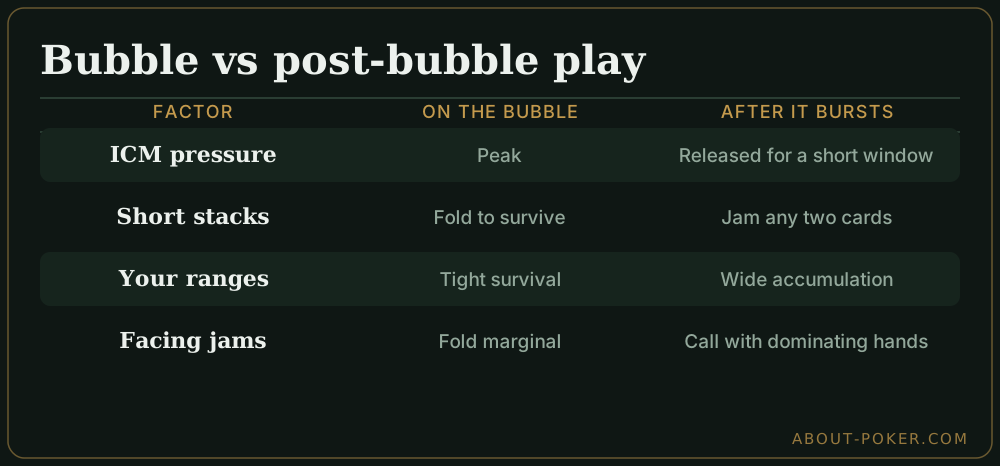
Because the min-cash tier is flat, the next several pay jumps are small, and chips regain close to linear value. That means building a stack is once again the highest-EV plan — the real money is deep, and a big stack is what gets you there. Widen your opening ranges, three-bet the loosened field, and stop protecting a stack that no longer needs protecting.
At the same time, you become the ideal target for loose short-stack jams, which is good news: you call their all-ins with a tighter, stronger range and let them gift you chips. When a 6 big blind stack jams any two into your 40 big blind stack, you get to pick the spots where you have them dominated. This is how you convert the post-bubble chaos into the ammunition you need for laddering and pay jumps later.
A worked example
You have 38 big blinds in middle position, three hands after the bubble burst. A player who folded relentlessly on the bubble now open-jams 7 big blinds under the gun, and it folds to you holding AQ suited.
Against a genuine early-position range this might be marginal, but the story matters: this opponent just spent an hour folding and is now unloading pent-up aggression, so their jamming range is far wider than normal. AQ suited crushes that range, dominating the many weaker aces and Broadways they are shoving. This is a clear call. You would have folded a similar spot on the bubble to protect your equity; now, with pressure released and their range blown wide open, calling to accumulate is exactly right.
Do not overcorrect into recklessness
The post-bubble window is soft, but it is a window, not the whole rest of the tournament. As the field thins and you approach the next real pay tier — the final two tables and beyond — ICM pressure returns and steepens. Blend your aggression accordingly: crush the immediate post-bubble looseness, then tighten as the jumps grow.
Also read the individual opponents. Not everyone loosens up after the bubble; some tight players keep folding, and you should keep stealing from them. The point is to match your ranges to the actual field, which is temporarily far more aggressive and exploitable than it was moments earlier.
Post-bubble checklist
- Recognize the phase change immediately — bubble-tight play is a leak once the bubble bursts.
- Widen your opens and three-bets to exploit the newly loosened field.
- Call loose short-stack jams with a strong, dominating range and let them bust into you.
- Prioritize accumulation while the pay jumps are flat and chips are near linear value.
- Re-tighten as you approach the next steep pay jumps and ICM pressure rebuilds.
Frequently asked
How does play change after the bubble bursts?
The intense ICM pressure that made everyone fold on the bubble evaporates for a short window, and desperate short stacks start jamming freely. You should shift from tight survival play to aggressive accumulation, opening wider and picking off loose all-ins with strong hands.
Should I gamble more right after the bubble?
Yes, but selectively. The flat min-cash tier means the next pay jumps are small, so chips regain close to linear value and a big stack is what wins the tournament. Attack the newly loosened field, but keep some discipline for the steeper jumps later.
Why do so many players bust just after the bubble?
Short stacks who folded everything to survive the bubble immediately shove any two cards once they are in the money, so a wave of all-ins hits the table. Many of them run into hands or clash with each other, which is exactly why the field thins so fast post-bubble.