Playing With Antes
How antes change tournament poker: bigger pots to steal, wider opening ranges, better defending odds, and how the big blind ante speeds up the game.
On this page · 6 sections
Antes are forced contributions every player makes to the pot before the cards are dealt, sitting on top of the blinds. That small change transforms tournament strategy: the pot is bigger before anyone acts voluntarily, so stealing it is worth more, defending it is cheaper in relative terms, and the whole game tilts toward aggression. If you play the ante stages the same way you played the early no-ante levels, you are leaving chips on the table every orbit.
Understanding exactly how antes reshape pot odds and ranges is one of the highest-leverage adjustments in tournament poker, and it kicks in the moment antes appear, usually in the middle stages.
What antes do to the pot
Without antes, the preflop pot is just the small and big blind — say 1.5 big blinds. Add a big blind ante and the starting pot jumps to 2.5 big blinds before anyone raises. That extra dead money is what everyone is fighting over.
The bigger the starting pot relative to the cost of stealing it, the more profitable a steal becomes. A raise to 2.2 big blinds risks 2.2 to win 2.5 instead of 1.5 — the reward-to-risk ratio improves, so you can open a wider range and still profit when everyone folds. This is the engine behind ante stealing.
Big blind ante versus traditional antes
Older structures had every player post a small ante each hand, which was slow and error-prone. The big blind ante replaced it at most events: the player in the big blind posts one ante that covers the whole table, usually equal to the big blind itself.
The total money in the pot is the same, but the game runs faster and the burden is spread evenly — you pay the full ante once per orbit when you are in the big blind, rather than a fraction every hand. Strategically the two are nearly identical; the pot is inflated either way, and your adjustments are the same.
A worked ante example
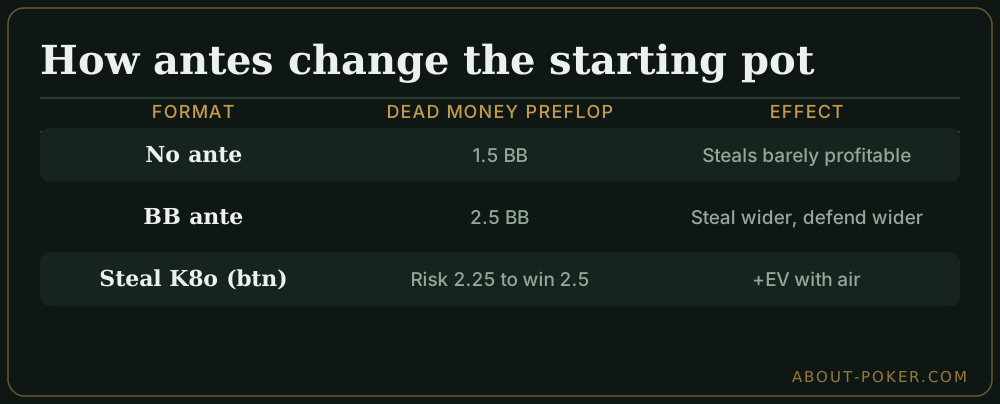
Blinds are 1,000/2,000 with a 2,000 big blind ante. The starting pot is 1,000 + 2,000 + 2,000 = 5,000, or 2.5 big blinds. It folds to you on the button and you open to 4,500 (2.25 BB) with K-8 offsuit — a hand you might fold in a no-ante game.
If both blinds fold, you win 5,000 by risking 4,500 — better than even money on a hand you did not have to show. Because the antes fatten the pot, this steal is profitable across a much wider range than it would be without them. Now flip to defense: you are in the big blind facing that 4,500 open. You are getting 5,000-plus-existing odds to call, so you defend far wider than you would if only the blinds were at stake.
Opening and defending wider
Antes push both sides of the steal battle toward aggression. As the raiser, open more hands from late position because the reward is higher. As the big blind, defend more often because the improved pot odds let you profitably continue with hands you would fold in a no-ante game — small suited connectors, weak aces, any two broadways.
This does not mean play every hand; it means shift your thresholds. The exact width depends on position and stack depth, but the direction is always the same: wider. See blind stealing and steal defense for the full ranges.
Common ante-stage mistakes
- Playing the same tight ranges you used before antes appeared, and folding away free equity.
- Over-folding the big blind despite the great pot odds antes provide.
- Min-raising too small and giving the blinds correct odds to defend everything.
- Ignoring the ante when counting your M or effective stack — antes eat your chips faster.
- Failing to attack the blinds when it folds to you in late position, the single best ante-stage spot.
Ante-stage checklist
Once antes are in play, add up the true starting pot before you act, open wider from late position, defend your big blind more, and count antes into your stack pressure. The pot is bigger, the game is faster, and the reward for aggression is real — play accordingly and you will out-chip the players still using their no-ante ranges.
Frequently asked
What is an ante in poker?
An ante is a forced bet every player contributes to the pot before the hand, on top of the blinds. It builds a larger starting pot, which rewards aggression because there is more dead money to win when you steal the blinds and antes.
What is a big blind ante?
A big blind ante is a single ante posted by the player in the big blind seat that covers the whole table, instead of each player posting a small ante individually. It speeds up the game and keeps the pot size the same, but shifts the full ante burden onto each player once per orbit.
How do antes change your strategy?
Antes reward aggression. Because the pot is bigger before any voluntary betting, steals are more profitable, so you should open wider and defend your big blind more often. Better pot odds also mean you can call and three-bet lighter than in a no-ante game.