Taking a Shot at Higher Stakes
How to take a shot at higher stakes the right way: how many buy-ins to risk, the stop-loss that keeps it safe, and a worked shot plan from start to finish.
On this page · 6 sections
Taking a shot is the smartest way to test water that is deeper than your bankroll strictly allows. You set aside a small, fixed number of buy-ins, sit in the bigger game, and if you lose them you drop straight back down — roll intact, ego intact. Done with a plan, a shot is a low-risk on-ramp to higher stakes. Done on impulse, it is just being under-rolled and calling it something braver.
What actually makes a shot “safe”
The word “shot” implies discipline, but plenty of players use it to dress up a reckless jump. The thing that makes a shot safe is boring and non-negotiable: you decide your stop-loss before you sit down. A shot with no pre-set exit is not a shot at all — it is moving up under-rolled and hoping to run good.
A real shot has three fixed parts, all set in advance: the amount you will risk (a few buy-ins), the trigger that ends it (your stop-loss), and where you go when it ends (straight back to your regular stake). Fix those three and a bad shot costs you a small, planned amount. Skip them and a bad shot can cost you the roll. This is the same discipline framework laid out in the full shot-taking guide.
How many buy-ins to risk
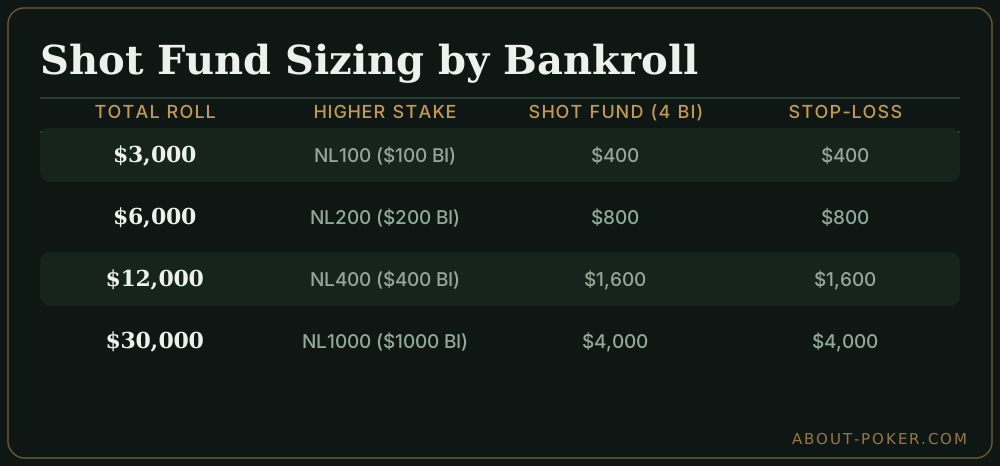
The standard is 3 to 5 buy-ins of the higher stake, or about 10 to 15% of your total bankroll — whichever is smaller for your situation. Why this range? Fewer than three buy-ins and one cold session ends the shot before you have learned anything about the game. More than five and a losing shot starts doing real damage to your roll, which defeats the purpose.
Think of the shot fund as tuition. You are paying a capped, known price to find out two things: can you beat this stake, and can you handle it emotionally? Both answers are worth the few buy-ins, and neither is worth your whole roll. Keep the rest of your bankroll walled off and untouchable during the shot.
The stop-loss: your single most important rule
Your stop-loss is the dollar figure — usually those 3 to 5 buy-ins — that sends you back down the instant you hit it. It has to be set before you sit, because in the moment, down four buy-ins at a bigger game, you will not think clearly. You will feel the pull to win it back at the level where you lost it, and that pull has ended more careers than any bad beat.
Set it, write it down, and honor it mechanically. When you hit the stop-loss you leave — even if you feel you were “just getting unlucky,” even if the game looks great. The whole value of a shot comes from the cap. Removing the cap removes the safety. If you struggle to leave, pair your stop-loss with a firm move-down rule so the exit is automatic.
A worked shot plan
You have a $6,000 roll and grind NL100 ($100 buy-in) profitably. NL200 needs $8,000 for a full move, so you are not ready to commit — but you want to test it. Here is a clean shot.
You set aside 4 buy-ins of NL200 ($800) as your shot fund, leaving $5,200 walled off as your working NL100 roll. Your stop-loss is that $800. Your exit is NL100. You sit at NL200 and play your normal game.
If it goes well: you finish the shot up $500. Your roll is now $6,500, and you bank the evidence that you can compete. A couple more successful shots and you push toward the full $8,000 threshold, then move up for real.
If it goes badly: you lose the $800, stand up the moment you hit the stop-loss, and return to NL100 with $5,200 — still fully rolled, still earning. You take another shot next month after rebuilding a little cushion.
Notice the outcome you avoided entirely: sitting at NL200 with no cap, losing 9 buy-ins, and being both broke for the stake and on tilt.
Common mistakes when taking a shot
- No stop-loss. The number-one killer. Without it, a shot is just an under-rolled move-up.
- Risking too much. More than 15% of your roll on one shot turns a normal loss into real damage.
- Chasing after the stop-loss. Playing “one more” past your cap is the exact tilt the cap exists to prevent.
- Shot-taking to recover losses. Never fire a shot to win back money. Shots are for opportunity, not repair — see the shot-taking rules.
- Not banking the lesson. Win or lose, review the shot honestly: were you actually competitive, or just lucky/unlucky?
A quick pre-shot checklist
- Am I already beating my current stake over a real sample?
- Have I set my exact stop-loss in dollars, before sitting?
- Is the shot fund capped at 3-5 buy-ins or ~10-15% of my roll?
- Is the rest of my bankroll walled off and untouchable?
- Is my exit — back to my regular stake — clear and automatic?
Answer all five and your shot is a smart, cheap experiment. Miss any and you are just gambling with a nicer name.
Frequently asked
How many buy-ins should I risk on a shot?
Typically 3 to 5 buy-ins of the higher stake, or roughly 10-15% of your total bankroll. That is small enough that losing the shot doesn't damage your roll, but large enough to give the higher game a fair sample rather than one unlucky session.
What is a stop-loss for a shot?
A stop-loss is the exact amount you'll risk before dropping back down, set before you sit. It's the single rule that separates a disciplined shot from just moving up under-rolled. When you hit it, you leave — win, lose, or 'almost.'
When should I take a shot instead of moving up permanently?
Take a shot when your roll is close to but not yet at the full threshold for the higher stake, you're already beating your current level, and the bigger game looks beatable. Move up permanently only once your roll comfortably clears the requirement.
What do I do if the shot goes badly?
You drop straight back to your regular stake with your main roll intact, and you take another shot later once you've rebuilt a little cushion. A failed shot is a normal outcome, not a disaster — that's exactly why you cap it at a few buy-ins.