Handling Coolers Emotionally
A cooler is when two strong hands collide and someone has to lose. Learn why coolers aren't mistakes, how they differ from bad beats, and how to let them go.
On this page · 6 sections
Handling coolers emotionally rests on one hard truth: a cooler is a hand nobody could fold, so there is nothing to regret. When your set runs into a bigger set, or your nut flush meets a full house, the money going in was correct — you were just on the wrong side of a rare collision. Coolers are the purest form of variance in poker, and learning to shrug them off is a genuine edge.
What a cooler actually is
A cooler happens when two players both make hands strong enough that folding is essentially impossible, and one of them has to lose a big pot. Classic examples:
- Set over set. You flop bottom set with 7-7 on 7-9-K; villain flopped top set with K-K. The money’s going in, and you’re drawing to one card.
- Full house over flush. You make the nut flush on the turn; the board pairs on the river and villain fills up.
- Aces vs kings preflop, all in. K-K is a premium hand you’d almost never fold, but A-A has it crushed at about 82% to 18%.
In each case, playing the hand aggressively was correct. That’s what makes coolers different from spew — you didn’t do anything wrong, the deck just dealt two big hands to two players.
Cooler vs bad beat: why the distinction matters
People blur these two, but they’re emotionally different. In a bad beat, you got the money in ahead and lost to a lucky card — your queens held 80% equity and the river brought an ace. In a cooler, you were often behind the entire time; the second-best monster never really had a chance.
Why does the distinction matter for your emotions? Because the cooler removes the “if only” story completely. With a bad beat you can at least point at a specific card that betrayed you. With a cooler there’s no villain, no bad card, no missed fold — just two great hands and simple bad luck of the seating. Ironically that makes coolers easier to accept once you see them clearly: there is literally nothing you’d do differently.
The “could I have folded?” trap
The most damaging response to a cooler is convincing yourself you should have seen it coming. “The board was scary, I should’ve folded my flush.” No — you shouldn’t have, and here’s why. The same board texture that occasionally produces the full house that beats you produces a winning flush the vast majority of the time. If you start folding the nut flush because a full house is possible, you throw away a fortune in the far more common spots where you’re good.
Think of it as a tax. To get paid on all the hands where your monster wins, you must occasionally pay off the rare hand where a bigger monster is lurking. Paying that tax is not a leak — refusing to pay it is. This is the essence of detachment from results: you grade the decision, and the decision to get it in with the nut flush is correct even on the day it loses.
A worked example
Cash game, $2/$5, both players 200 big blinds deep. You have Q-Q, raise, and get called by a solid regular. Flop: Q-8-3 rainbow — you’ve flopped top set, the near-nuts. You bet, he raises, you three-bet, he calls. Turn: 8, pairing the board and giving you a full house, queens full of eights. You bet big, he shoves. You call instantly.
He turns over 8-8 — flopped a set of eights, turned quad… no, turned trips into quads? He has four eights. Your queens-full is drawing dead. You got a huge pot in with the second nuts on the turn, behind only to exactly four combinations of one specific hand.
Was there a fold here? Absolutely not. Folding queens-full on that turn would be a catastrophic error that costs you money against every other hand in his range. You played it perfectly and lost to a one-in-a-hundreds collision. That’s a cooler — and the only correct emotional response is to reload and keep playing your game. This is exactly where emotional control separates winners from tilters.
How to let a cooler go, in the moment
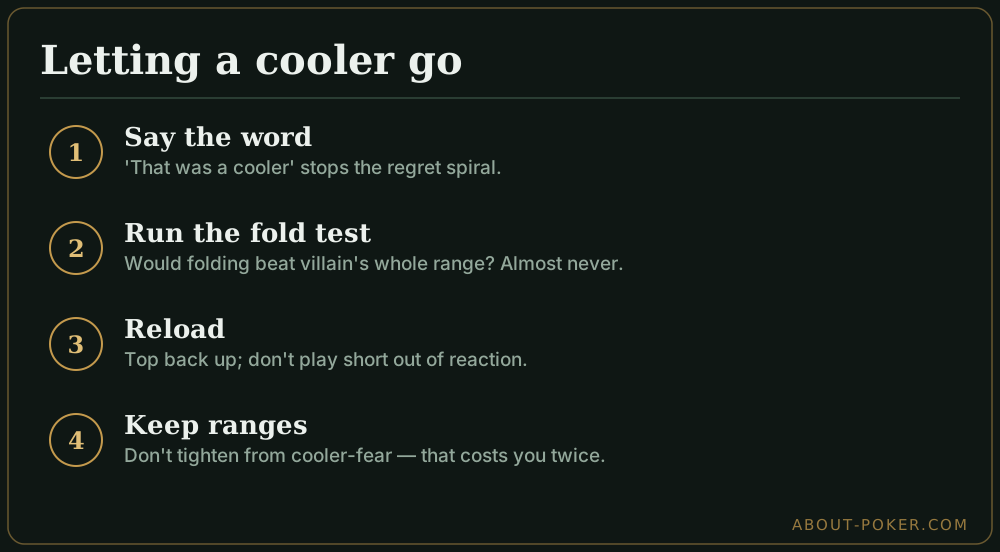
- Say the word. “That was a cooler.” Naming it as unavoidable stops the regret spiral before it starts.
- Do the fold test honestly. Ask: would folding here be correct against villain’s whole range? If no — and it almost always is no — you’re done. There’s nothing to fix.
- Reload without hesitation. In cash, top your stack back up. Playing short after a cooler is itself a small tilt reaction.
- Do not tighten up. The worst reaction is to start playing scared, folding strong hands out of cooler-fear. That’s the cooler costing you twice.
Cooler checklist
- Distinguish it from a bad beat: were you behind the whole way? Then it’s a cooler.
- Run the honest fold test — you’ll almost always find the get-in was correct.
- Accept coolers as the tax you pay to get paid on all your winning monsters.
- Reload, keep your ranges the same, and refuse to play scared afterward.
- Move on within one hand — a cooler you dwell on becomes a leak you can’t blame the deck for.
Coolers are the price of admission for playing your big hands strongly. Pay it calmly, and the deck’s rare cruelty stops costing you anything beyond the pot itself.
Frequently asked
What is a cooler in poker?
A cooler is a hand where two players both make very strong holdings and the money goes in almost unavoidably — like set over set, or the nut flush against a full house. Someone has to lose a big pot, and there was no realistic way to fold. It's variance, not a mistake.
What's the difference between a cooler and a bad beat?
In a bad beat you get the money in as the favorite and lose to a draw or a lucky card. In a cooler, both players have monster hands and the loser was simply on the wrong side of a rare collision — often behind the whole way. Coolers are usually unavoidable; bad beats involve getting outdrawn.
Could I have folded to avoid the cooler?
Almost never, and trying to would cost you far more over time. If you start folding sets and flushes because a cooler is theoretically possible, you'll fold the winning hand in the same spot thousands of times. Paying off a rare cooler is the price of getting paid on all the normal hands.