Filtering Hand Histories
Turn a pile of hand histories into answers — the filters that isolate your real leaks by position, line, board, and street, with a worked example.
On this page · 6 sections
A hand history database is only as useful as the questions you can ask it, and filters are how you ask. Left unfiltered, your stats are one giant average that smears together every position, every stack depth, and every line — so a real leak in one spot gets cancelled out by good play in another, and you never see it. Filtering slices the database down to a single, clean situation where the numbers actually mean something. This is the practical skill that makes online poker analysis software worth running.
Why aggregate stats lie
Say your overall river aggression looks healthy. That number is the blend of your button play (where you correctly bet thin and bluff often) and your out-of-position play (where you might barrel into calling stations and never give up). The two errors point opposite directions, so the average looks fine while both spots leak money. The only way to see it is to filter the two situations apart. Aggregate stats answer “how do I play in general,” which is almost never a question you can act on. Filtered stats answer “how do I play this spot,” which you can fix tonight.
Filter broad to narrow
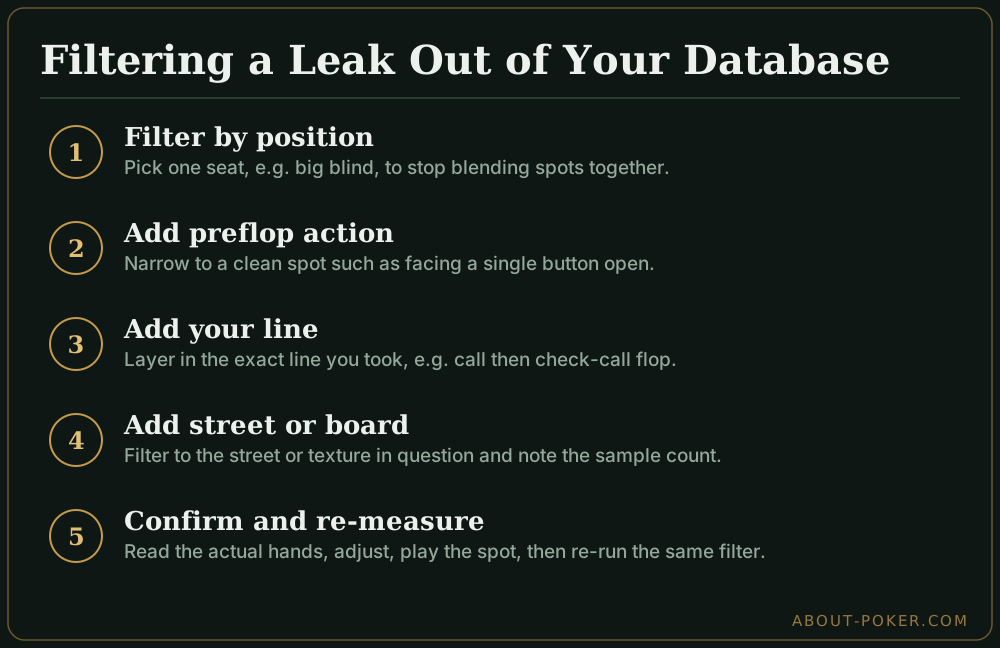
The reliable workflow is to start wide and add one filter at a time, watching the hand count as you go. A good sequence:
- Position — pick one, e.g. big blind.
- Preflop action — e.g. facing a single raise, no three-bet.
- Your line — e.g. you called preflop, then check-called flop.
- Street / board — e.g. turn brought a flush-completing card.
Each layer shrinks the sample. If after step two you have 8,000 hands and after step four you have 40, you have gone too narrow to trust the numbers — but 40 hands is plenty to open and read one by one, which is often the better move anyway. Keep the sample count on screen so you always know whether you are looking at statistics or at anecdotes.
A worked example
Suppose you suspect you fold too much in the big blind. Here is the filter stack and what to look for.
Filter: hero in big blind, facing a button open, no limpers, single raise. Say this returns 3,100 hands. Now look at your fold-to-steal — imagine it reads 68%. Against a button opening a wide range, defending only 32% of the time is far too tight; a rough MDF-style benchmark against a 2.5x button open wants you continuing with something closer to 55-60% of hands. That gap is a concrete, quantified leak worth real money because it happens constantly.
Now add one more filter: flop check, hero faces a c-bet. Say fold-to-flop-c-bet reads 62% here. You are folding the flop too often after already defending too little preflop — you are giving up twice. Open ten of those folded hands and you will usually find middle pair, gutshots, and backdoor equity you should have continued with. The filter found the leak; reading the hands confirmed it. Pair this with what the numbers mean in online poker stats explained.
Sample size discipline
The single biggest mistake in database work is trusting a tiny filtered sample. A 3-bet-bluff frequency computed over 12 opportunities tells you nothing. Rough guides: broad frequencies (VPIP, PFR, fold-to-steal) start to mean something in the low thousands of hands; line-specific frequencies (turn check-raise, river bluff) need many more occurrences, often 50-plus of the exact spot before the percentage is stable. When the sample is thin, switch modes — instead of trusting the stat, read every hand in the filter.
Filters that consistently find money
A few filters that reliably surface leaks:
- Fold to c-bet by position — usually reveals over-folding out of position.
- River bet/raise frequency — often reveals under-bluffing rivers.
- Went-to-showdown when you called the river — a low win rate here means you call too many rivers you lose.
- Big pots lost (biggest losing hands) — sort by pot size and read the ten worst; recurring spot types jump out.
Turning filters into fixes
Filtering is diagnosis, not treatment. The loop is: filter to a spot, confirm the leak by reading actual hands inside it, decide the correct adjustment, then play a few hundred hands attacking that spot, and re-run the same filter to see if the number moved. That closed loop — filter, confirm, adjust, re-measure — is the engine of improvement described in how to get better at online poker. A database without filters is a shoebox of receipts; with filters it becomes a map of exactly where your money leaks.
Frequently asked
What is the point of filtering hand histories?
Raw stats over your whole database blend every spot together and hide leaks. Filtering isolates one clean situation — say, defending the big blind versus a button raise — so the numbers describe a decision you can actually study and fix. Without filters you see averages; with filters you see mistakes.
How many hands do I need before a filtered stat is meaningful?
It depends on how often the spot occurs. Broad stats like VPIP stabilize in a few thousand hands, but a narrow filter like river check-raise frequency may need tens of thousands to hold enough samples. Treat any filtered result under a few dozen occurrences as a hint, not proof.
Which filters should I start with?
Start with position and preflop action — for example, everything where you were in the big blind facing a single raise. From there add the line you took and the street. Layering broad-to-narrow keeps sample size visible so you know when a result is real versus noise.
Can filtering show leaks I didn't know I had?
Yes, that is its main value. Filtering by board texture or by specific lines often surfaces spots where you fold too much or bluff too little — patterns invisible in aggregate stats. The tracker points; you confirm by reviewing the actual hands inside the filter.