How to Get Better at Online Poker
How to get better at online poker: build a study routine, review your own hands, fix one leak at a time, and grow volume without breaking your bankroll.
On this page · 10 sections
Why do so many players log thousands of hands and never improve? Almost always because they only play. Hands stream by, tough spots get auto-piloted, the same mistake repeats for months — and volume alone teaches none of it out of them. Getting better runs on a different loop: play to build volume, review to build skill, fix one leak, repeat. Talent helps a little; a study habit does nearly all the work.
Treat playing and studying as two separate jobs
At the table, under a shot clock and often across several tables, you make dozens of snap decisions and can’t stop to reason through any single one. That’s fine — the on-table job is just to make your best guess and flag the hands you’re unsure about. The actual learning happens later.
Away from the table you can pause, consider your opponent’s likely range, weigh alternative lines, and work out why one play beats another. An hour of that focused review can teach you more than a full grinding session. So split your effort deliberately:
- On-table: make the best decision you can, and mark the spots that felt hard.
- Off-table: go back over those flagged hands calmly, without the clock, and figure out what was actually correct.
A study loop you’ll actually repeat
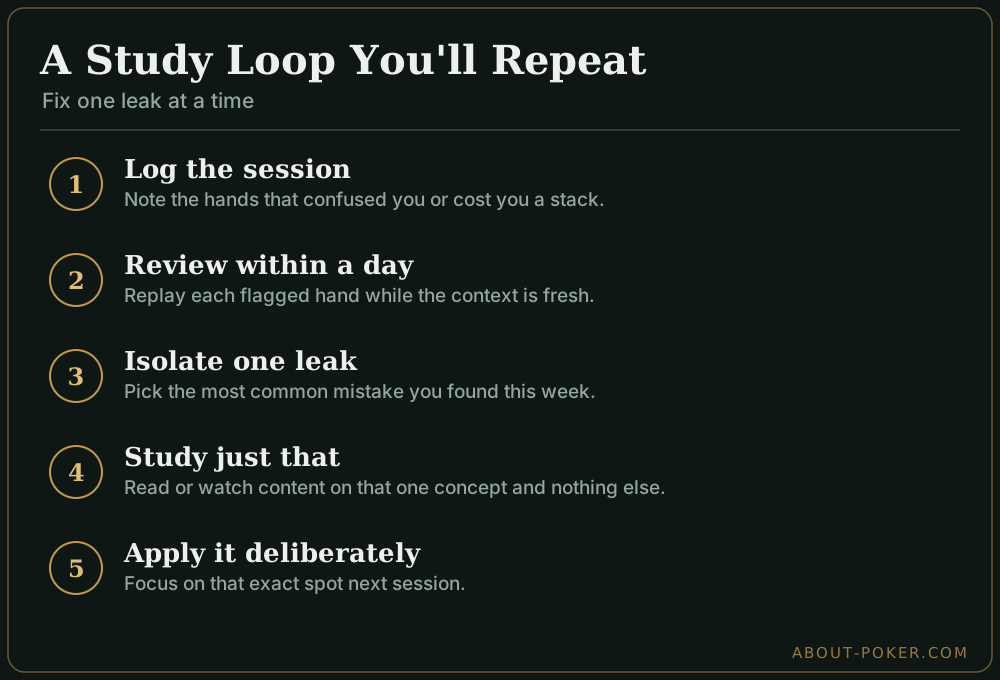
You don’t need a rigid schedule — you need a cycle you’ll come back to:
- Log the session, noting the hands that confused you or cost you a stack.
- Review within a day, while the context is fresh, replaying each flagged hand.
- Isolate one leak — the most common mistake you found this week.
- Study just that, reading or watching content on that one concept and nothing else.
- Apply it deliberately next session, focusing on that spot specifically.
The discipline that makes this work is fixing one leak at a time. Overhaul your whole game at once and you improve at nothing; drill a single concept for a week — say, defending your big blind correctly — and it sticks. Five concepts skimmed don’t.
Let your data tell you the truth
Tracking software is a mirror. Even without a live HUD, the database it builds lets you audit your own tendencies after the fact. Filter for your big losing pots and look for a repeating pattern; check your VPIP/PFR to see whether you’re playing too many hands or too passively; hunt for spots where you over-call out of position or under-defend your blinds. Our HUD and tracking tools basics explains how to read those numbers, and the tools and software hub covers what’s available. The catch is honesty — the data will surface leaks your ego would rather ignore.
Know which numbers to trust — and what to aim for
Data only helps if you read it at the right sample size. Frequency stats settle fast: your VPIP/PFR are meaningful after a few thousand hands, so you can act on them almost immediately. Your win rate is the opposite — over a few thousand hands it’s mostly noise, starts becoming a rough signal around 50,000, and only firms up near 100,000+. That’s why you judge your play by decisions, not by a win-rate line that hasn’t earned the right to be believed yet.
For a rough target, healthy 6-max online cash benchmarks look like this:
| Stat | Too loose/passive | Solid winning range | Reading |
|---|---|---|---|
| VPIP | over ~30% | 22–26% | How often you enter a pot |
| PFR | under ~15% | 18–22% | How often you raise first in |
| VPIP–PFR gap | over ~8 | 3–5 | Big gap = too much limping/calling |
Full-ring games run tighter — knock VPIP/PFR down a few points. Treat these as guardrails, not laws: a 24/20 line with a 4-point gap is a reasonable place to be before you start tuning by opponent.
Pick better games, don’t just play better
Online, your biggest single edge is often which table you sit at, not how you play once you’re there. Use the lobby: sort tables by average pot size and players-per-flop, and prefer seats with a high flop percentage and a short waitlist — loose, passive tables print money in a way a tough reg table never will. Sit to the left of the biggest fish so you act after them, leave a table the moment it turns nitty or a strong player sits down, and don’t get attached to a seat out of pride. An hour spent in good games beats two hours grinding break-even tables.
Add tables without adding leaks
As a volume tool, multi-tabling is a tradeoff, not a free upgrade. Each extra table raises your hands-per-hour but lowers your decision quality, and past a point your win rate per hand drops faster than volume makes up for it. The fix is to grow tables slowly: add one only once your current count feels boring rather than busy, and drop back the instant you catch yourself auto-piloting flagged spots. Two tables played with full attention will teach you more — and often earn more — than six played on reflex. Volume builds the sample; quality builds the skill, and you need both.
Warm up, and quit before you leak
Treat a session like a workout: warm up and cap the length. Before you sit, spend five minutes reviewing yesterday’s flagged hands or your current leak so you start engaged instead of cold. Keep sessions to a length you can hold focus for — for most players that’s roughly 60–90 minutes before concentration slips — then take a real break. And set a hard stop-loss: if you drop two or three buy-ins and feel tilt creeping in, end the session. The worst decisions come at the tired, frustrated end of a grind, and no amount of good play earlier makes up for spewing a stack there.
Study away from the felt: use the tools
Self-review tells you what you did; solvers and trainers tell you what was correct. Once you’ve isolated a leak, take that exact spot to a GTO solver (to see the equilibrium play) or a GTO trainer (to drill it against feedback until the right action is automatic). You don’t need to memorize solver output — use it to answer one specific question at a time, like “how wide should I defend my big blind versus a button raise?”, then take that single answer back to the tables. Pair this with your own hand history, not instead of it: the solver shows the target, your database shows how far off you are.
Where the effort pays off
Skill compounds in stages, and skipping one leaves gaps you’ll pay for later:
| Stage | Focus | What “better” looks like |
|---|---|---|
| Beginner | Position, hand selection, bet sizing | Stops spewing chips in obvious spots |
| Developing | One leak at a time via review | Beats a single low-stakes table steadily |
| Solid | Ranges, board texture, opponent types | Wins over thousands of hands, not luck |
| Advanced | Exploiting reads, thinner value and bluffs | Adjusts to opponents, adds tables profitably |
The online poker tips cover the fundamentals that anchor the whole ladder.
Judge yourself by decisions, not by your balance
The hardest discipline is reading your own progress correctly. A losing week doesn’t mean you got worse and a winning week doesn’t mean you got better — short-term results are dominated by variance, as our guide to swings and variance explains. Chase results directly and you pick up bad habits: after a loss you tilt and try to win it back, after a win you get careless.
So attach your self-assessment to the process instead of the money. Did I follow my study loop? Did I make sound decisions? Did I fix the leak I set out to fix? Get the process right and, given enough hands, the results follow. Reverse that priority and you’ll ride the variance up and down while learning nothing — which is exactly how a player logs a year of hands and ends it no stronger than they started.
Frequently asked
Should I move up stakes to get better?
Not to learn. Move up only once you're beating your current game over a meaningful sample and your bankroll supports it. Playing above your level exposes leaks without teaching you to fix them, and it wrecks your bankroll while you find out.
Do I need coaching or courses to improve?
No, though structured content speeds things up. Most improvement comes from disciplined self-review, studying one concept at a time, and applying it deliberately. Free resources plus honest analysis of your own play take you a long way before paid coaching pays off.