Playing Online Sit & Gos
How to play online sit & gos: the single-table tournament structure, tight-early loose-late strategy, bubble and ICM pressure, and a stage-by-stage game plan.
On this page · 6 sections
Sit & gos are the best training ground in online poker. A single table, a fixed buy-in, a clear payout ladder, and a definite end make them a complete tournament in miniature — every skill that matters in a big field shows up here in a form you can play dozens of times a day. Learn to navigate the arc from a deep-stacked, patient start to a short-stacked, aggressive finish, and you will have the core of tournament poker in your hands.
The structure that shapes everything
A classic single-table sit & go seats nine or ten players, starts the moment the seats fill, and pays the top three — often something like 50% to first, 30% to second, 20% to third. You begin with a comfortable stack relative to the blinds, but the blinds rise on a timer, so the effective stacks shrink steadily whether or not you win chips. That shrinking is the engine of sit & go strategy: the correct way to play changes completely as the blinds climb and players bust.
Think of the game in three phases — early, middle, and the bubble/endgame — each demanding a different gear. For the wider tournament context, our online poker tournament strategy guide covers multi-table fields; here the compressed structure just makes those lessons arrive faster.
Early: tight and patient
In the first few levels, stacks are deep relative to the blinds and the pots are small. There is very little to win by getting fancy and a lot to lose by spewing your stack early. Play tight, enter pots with strong hands and good position, and avoid marathon bluffs against opponents who are not going anywhere.
The reason is pure risk-reward: winning a small early pot barely moves your stack, but losing a big one can cripple your chances at the money. Preserve chips, gather information on your table, and let the impatient players eliminate themselves. You do not win a sit & go in the first level, but you can certainly lose it there.
Middle: open up as blinds bite
As the blinds rise and the table thins to five or six players, the math flips. Now the blinds and antes are worth stealing, stacks are shallower, and passivity leaks chips. This is the time to open more hands, attack the blinds from late position, and put opponents to decisions. Sitting back waiting for premiums while the blinds eat your stack is a slow death.
Position and stack size become your main guides. With a healthy stack you pressure the shorter stacks who cannot fight back cheaply; with a shrinking stack you look for good spots to shove before you are too short to have fold equity.
The bubble and ICM
When four players remain and three get paid, you hit the bubble — the highest-leverage moment in the game. Here the payout structure warps everything through ICM (Independent Chip Model), the idea that a chip you might win is worth less than a chip you might lose because survival itself has value near the money. That single fact changes correct play more than any other.
Practically, ICM means the big stack should hammer the medium stacks who desperately want to fold into the money, while medium stacks tighten up to avoid busting on the bubble. The short stack, with little to lose, can gamble. Understanding who is under pressure and exploiting it is where sit & gos are won.
A worked example: bubble pressure with the big stack
Four players left, three paid. You are the chip leader with 25 big blinds. On your left sits a medium stack of 12 big blinds who clearly wants to fold into the money; the two others are short. It folds to you on the button with K-8 offsuit.
In a cash game K-8o is a marginal steal. On this bubble it is a strong shove or raise, because the medium stack cannot profitably call and risk busting one spot from the cash — even with a decent hand, ICM makes calling off 12 big blinds a losing play for them. You are not risking your tournament so much as leveraging their fear: they fold far too often, you collect the blinds and antes repeatedly, and you extend your lead toward the win without ever showing a hand. Take that same aggression as a medium stack, however, and you would be gambling your own survival away — the pressure only works from the stack that can afford it.
A stage-by-stage checklist
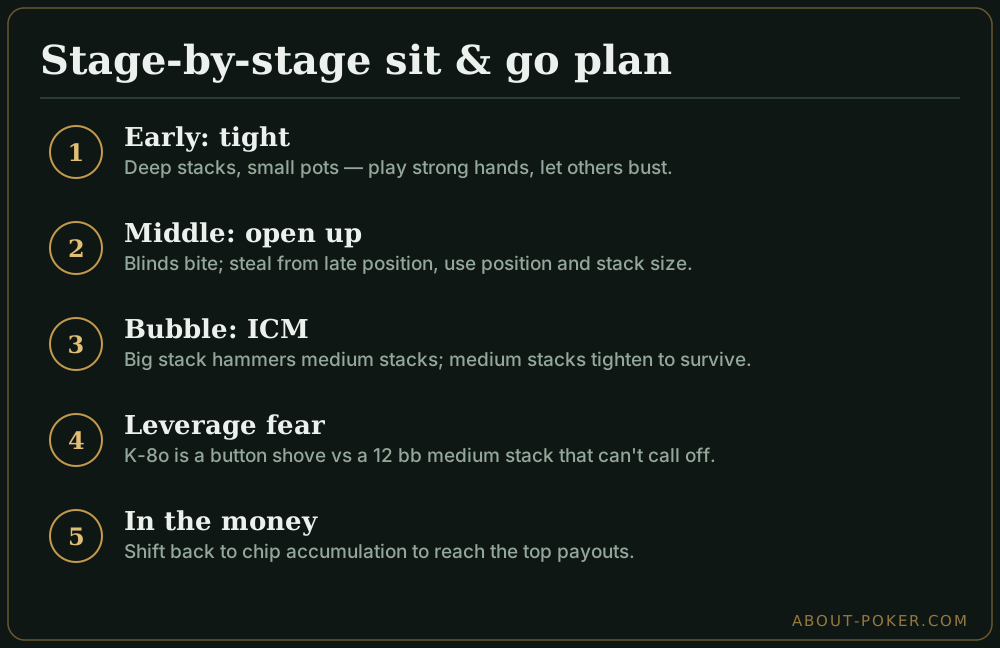
- Early: play tight, avoid big pots, and let others bust themselves.
- Middle: open up, steal blinds, and use position as the blinds start to bite.
- Bubble: apply ICM pressure from a big stack; tighten to survive from a medium one.
- In the money: shift back toward chip accumulation to reach the top payouts.
- Always: buy in only at stakes your roll supports — see online poker bankroll for beginners — because tournament variance is high even single-table.
Master that arc — patient, then aggressive, then ICM-aware — and single-table sit & gos become both a steady format to profit in and the fastest way to build every tournament skill you will ever need in a larger field.
Frequently asked
What is a sit & go in online poker?
A sit & go is a small tournament that starts as soon as enough players register rather than at a scheduled time. The classic form is a single nine or ten-player table paying the top three, though many sizes and speeds exist. It combines a fixed buy-in, a clear payout ladder, and a defined endpoint, which makes it ideal for learning tournament skills.
What is the basic strategy for single-table sit & gos?
Play tight in the early levels when stacks are deep and blinds are small, then open up sharply as blinds rise and the field shrinks. Near the bubble, use your stack to pressure medium stacks who are afraid to bust, and adjust every decision for the payout jumps rather than just chip equity.
Do payouts change how I should play a sit & go?
Yes, dramatically. Because a top-three payout is top-heavy and chips are worth less as you accumulate them, survival gains value near the money — this is ICM. It means you fold some hands that would be clear calls in a cash game and apply extra pressure on players who cannot afford to bust.