Using Preflop Charts Online
Using preflop charts online turns fast decisions into automatic ones. How to read range charts by position, apply them while multi-tabling, and adjust.
On this page · 6 sections
Using preflop charts online is one of the fastest ways to plug leaks, because most money is won and lost before the flop. A chart is simply a map of which hands to play from each position and how — raise, call, three-bet, or fold. Online play makes charts especially powerful: you can keep them on a second monitor, decisions come at you quickly, and consistency matters more than flashy creativity.
What a preflop chart actually shows
The standard chart is a 13×13 grid of the 169 starting-hand combinations. Pairs run down the diagonal, suited hands sit above it, offsuit hands below. Colors mark the action: for example, one color for “raise first in,” another for “three-bet,” another for “call,” and blank for “fold.”
There isn’t one chart — there’s a family of them:
- RFI (raise first in): what to open when the pot is unopened, by position.
- Facing a raise: when to call, three-bet, or fold to an open.
- Facing a three-bet: when to four-bet, call, or fold.
- Blind defense: how wide to defend the big blind versus different open sizes.
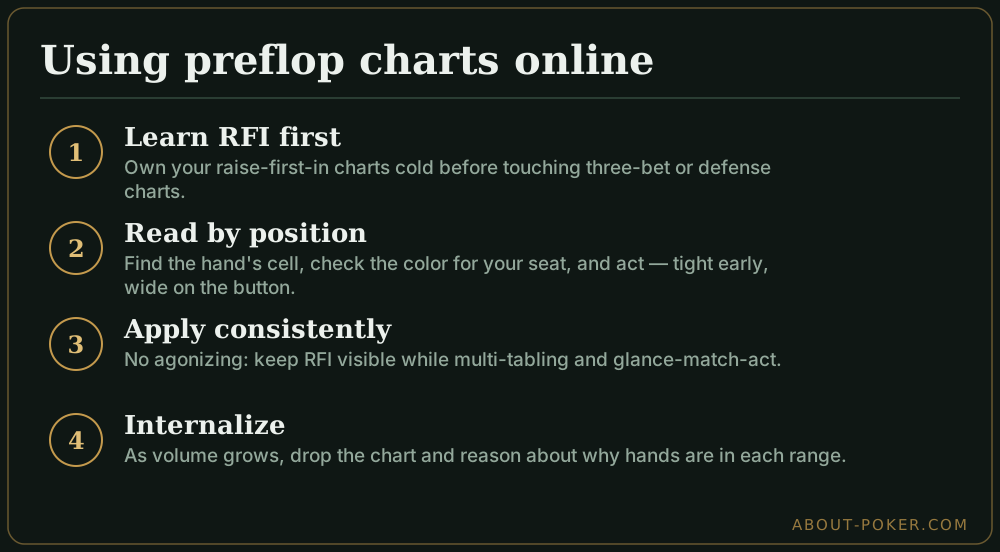
Beginners should own the RFI charts cold before touching the rest. That single foundation drives most of your win rate, and it pairs directly with online cash game strategy once the flop comes.
Reading a chart by position
Position drives everything. From under the gun you open tight; on the button you open wide because you’ll act last on every street. A typical 6-max RFI progression looks like:
- UTG: ~15% (88+, ATs+, KQs, AJo+, KQo).
- MP: ~18%.
- CO: ~26%.
- BTN: ~45%+.
- SB: raise-or-fold, roughly 40% as a raise.
When you look up a hand, you find its cell, check the color for your position, and act. The whole point is speed and consistency — no agonizing, no talking yourself into A8o under the gun.
A worked example
You’re dealt A♦J♦ in the cutoff, folded to you. Your RFI chart shows AJs as an open from the cutoff — raise to 2.3–2.5bb. Now the button three-bets. You switch to your “facing a three-bet” chart: AJs from cutoff versus a button three-bet is typically a call in position (occasionally a light four-bet as a bluff mix, but call is the clean default). You call, planning to use position postflop.
Compare that to A♦J♦ in the big blind facing a cutoff open: your blind-defense chart says defend by calling, not three-betting, because AJo/AJs from the blinds plays fine as a call closing the action. Same two ranks, three different actions depending on position and the chart in front of you. That’s the discipline charts give you.
Using charts while multi-tabling
Charts and volume are natural partners. When you’re running several tables, you don’t have time to reason out every open from scratch — you glance, match, act. Keep the chart you use most (RFI) visible at all times and pull up the situational charts as needed. If you’re scaling table count, read multi-tabling online poker; the more tables you add, the more you should lean on charts to keep your preflop game mechanical and error-free.
Common mistakes
- Chart-hopping mid-hand and misreading a cell under time pressure. Learn RFI cold so you rarely look it up.
- Ignoring open sizing. A chart assumes a standard raise size; if villains open huge, defend tighter than the chart’s default.
- Treating charts as final answers. They’re strong defaults, not exploits. Deviate deliberately, not randomly.
- Never graduating. Charts are training wheels. Over time, internalize them and start reasoning about why a hand is in the range.
From charts to understanding
The goal isn’t to read a chart forever — it’s to stop needing one. As you log volume, patterns stick: you’ll know button is wide, early position is tight, and blind defense hinges on price. Charts accelerate that learning, which is why getting better at online poker almost always runs through a phase of strict chart use. Start with RFI, add situational charts one at a time, and follow them consistently. Consistency before creativity is how preflop charts turn into a real, lasting edge.
Frequently asked
Is it legal to use preflop charts online?
On almost every site, static reference charts you glance at are allowed the same way strategy notes are. What sites prohibit is real-time assistance software that reads the table and tells you what to do. A printed or on-screen chart you read yourself is fine — check your site's rules to be sure.
Which preflop chart should a beginner start with?
Start with a simple 6-max opening (RFI) chart organized by position. Master just your raise-first-in ranges before adding three-bet, calling, and blind-defense charts. One clean opening chart followed consistently beats a stack of charts used inconsistently.
Do preflop charts still work against weak players?
Yes, as a baseline. Charts give you a solid, unexploitable default. Against very loose or very tight opponents you can deviate for more profit, but the chart keeps you from making large mistakes while you learn where deviations are worth it.