What a Poker HUD Shows
A poker HUD overlays opponent stats on your table. Learn what VPIP, PFR, 3-bet, and other core numbers mean and how to read them at a glance.
On this page · 8 sections
A poker HUD (Heads-Up Display) overlays statistics about every opponent directly onto your online table, pulled from a database of hands you have played against them. Instead of trying to remember how each player behaves, you glance at a few numbers and instantly know who is tight, who is loose, and who is aggressive. Here is what those numbers actually mean and how to read them.
The core three stats
If you learn nothing else, learn these three. Together they profile any opponent.
VPIP — Voluntarily Put money In Pot. The percentage of hands a player chooses to play (calling or raising, not counting the blinds they are forced to post). A high VPIP means loose; a low VPIP means tight.
PFR — PreFlop Raise. The percentage of hands a player raises before the flop. Comparing PFR to VPIP tells you how they play their hands: if PFR is close to VPIP, they raise most hands they play (aggressive); if PFR is much lower than VPIP, they call a lot (passive).
3-bet %. How often a player re-raises preflop. A low 3-bet (2–4%) means they only re-raise premium hands; a high 3-bet (8%+) means they re-raise light and you should not fold everything to their aggression.
These three appear on nearly every HUD and are covered in more depth in our online poker stats explained guide.
Reading player types at a glance
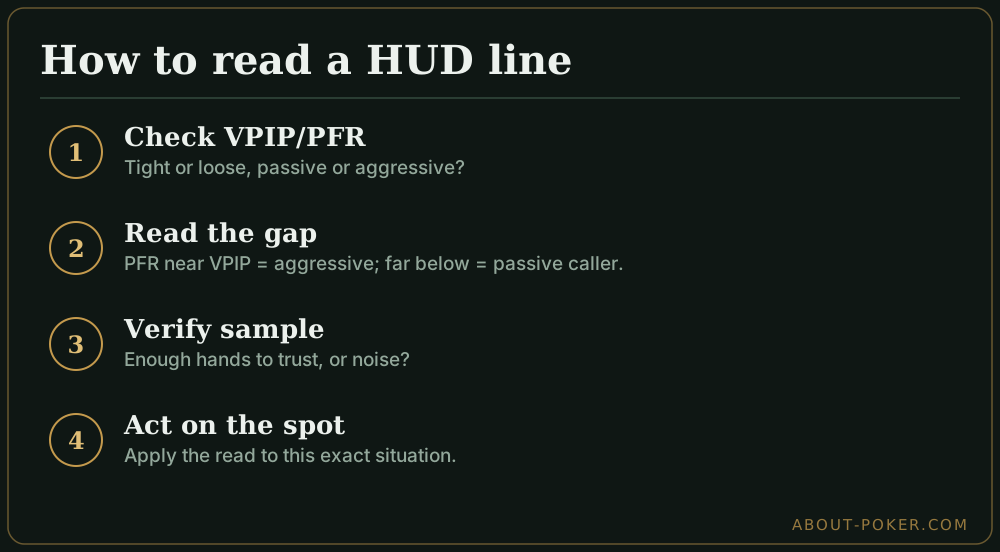
The magic of a HUD is turning numbers into a player type in one second:
- 22/19 (VPIP/PFR): a solid, tight-aggressive regular. Respect their raises.
- 45/8: a loose-passive fish who plays too many hands and rarely raises. Value bet them relentlessly, bluff them rarely.
- 30/26: a loose-aggressive player. Expect pressure; be ready to call down lighter and trap.
- 14/11: a nit. They fold too much — steal their blinds and fold to their aggression.
That single line of numbers replaces dozens of hands of observation, which is exactly why HUDs are so valuable when multi-tabling online poker — you cannot watch eight tables closely, but you can read eight lines of stats.
Postflop stats
Beyond preflop, most HUDs show:
- C-bet % — how often a player continuation-bets the flop after raising preflop. A high number means their flop bet is not always strong.
- Fold to c-bet — how often they fold to a continuation bet. High means you can c-bet them relentlessly; low means they float and you need real hands.
- Aggression frequency / factor — a summary of how often they bet and raise versus call across postflop streets.
- WTSD (Went To ShowDown) and W$SD (Won money at ShowDown) — how often they see showdowns and how often they win when they do. A high WTSD with low W$SD is a calling station paying you off.
A worked example
You are on the button, folded to you, and the big blind’s HUD reads 12/9, Fold to Steal 78%. That is a nit who folds to blind steals nearly four times out of five. You raise any two reasonable cards here for an immediate profit: you risk 2.5 big blinds to win the 1.5 blinds already in the pot, and because they fold 78% of the time, your steal shows a clear profit before a single flop is dealt. The specific cards barely matter — the HUD told you the player folds, so you attack the spot.
Now flip it: the big blind reads 38/10, Fold to Steal 22%. This player defends wide and calls a lot. Here you tighten your stealing range, because a random hand will get called and you will be playing a flop out of position against a station. Same seat, opposite play — driven entirely by two HUD numbers.
Sample size matters
The most common HUD mistake is trusting tiny samples. VPIP and PFR settle down after a few hundred hands, but specific stats — river aggression, 3-bet versus a button steal, fold to a check-raise — can take thousands of hands to become reliable. If a stat is based on 6 hands, it is noise, not signal. Good HUDs let you require a minimum sample before showing a number, and disciplined players lean on the high-sample stats (VPIP, PFR) early and add the specific ones only as data accumulates.
Getting set up
A HUD needs a tracking program that stores your hand histories and reads them in real time. Our online poker HUD and tools basics guide walks through installation and configuration, including which stats to display so your overlay stays readable rather than cluttered.
Common mistakes
- Trusting small samples as if they were reliable reads.
- Cluttering the HUD with 20 stats you never actually use — start with the core three plus a couple of postflop numbers.
- Playing the stat, not the situation — a 3-bet% is an average across spots; the specific board and history still matter.
- Forgetting HUDs are banned on some sites — many rooms now restrict or prohibit them, so check the rules before relying on one.
Quick checklist for reading a HUD
- Check VPIP/PFR first — tight or loose, passive or aggressive?
- Is the sample big enough to trust this stat?
- What does the specific number tell me to do in this spot?
- Am I overloading my display, or keeping it to stats I actually use?
Learn to read those few numbers fluently and a HUD turns anonymous online opponents into an open book.
Frequently asked
What is a poker HUD?
A HUD (Heads-Up Display) is software that overlays statistics about your opponents directly onto the online table. It reads your hand-history database and shows numbers like how often each player enters pots and raises, letting you profile opponents at a glance without memorizing every hand.
What are the most important HUD stats?
For most players the core three are VPIP (how often a player voluntarily puts money in the pot), PFR (how often they raise preflop), and 3-bet percentage (how often they re-raise preflop). These three tell you whether an opponent is tight or loose and passive or aggressive.
What is a good VPIP?
It depends on the format, but in 6-max cash a solid regular typically runs a VPIP of roughly 22–28% with a PFR close behind. A VPIP much higher than PFR signals a loose-passive player who calls a lot, while VPIP and PFR being close signals an aggressive player.
Do I need a lot of hands for HUD stats to be reliable?
Yes. VPIP and PFR stabilize after a few hundred hands, but more specific stats like river aggression or 3-bet-versus-steal need thousands of hands to be trustworthy. Reading a small sample as gospel is a common and costly mistake.