Mixed Game Rotation Tips
Mixed game rotation tips: how to bank chips before a game switch, exploit specialists, and stay sharp across HORSE and 8-game orbits. A practical guide.
On this page · 6 sections
In a mixed game the variant on the table changes at a fixed point — usually once per orbit, sometimes every set number of hands, and in tournaments at every level. Most players think of rotation as a scheduling detail. It is actually a strategic lever: knowing when the game will change lets you bank value in your strong rounds, dodge trouble in your weak ones, and pounce on opponents who only understand half the games in the mix.
If you are still learning the running order, start with HORSE poker strategy for the classic five-game rotation, then come back here for the timing edges that sit on top of it.
How rotation actually works
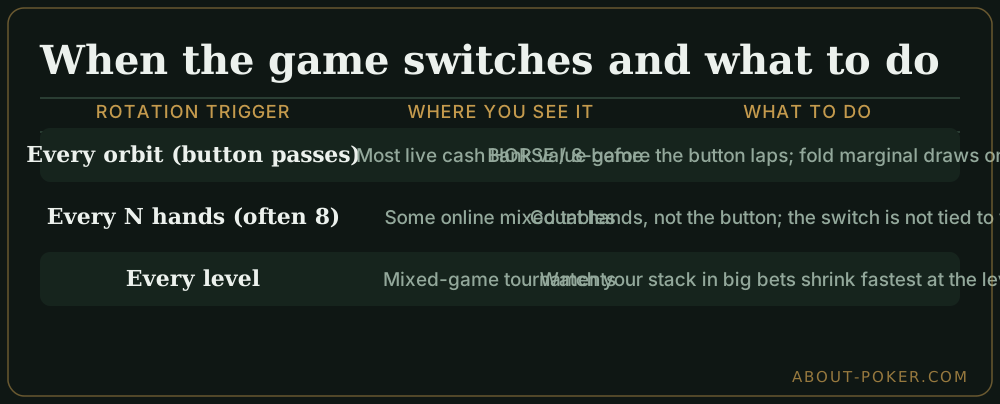
There are three common triggers for a game switch. Knowing which one your table uses is the whole ballgame.
| Rotation trigger | Where you see it | What it means for you |
|---|---|---|
| Every orbit (button passes) | Most live cash HORSE / 8-game | Game changes once the button completes a full lap |
| Every N hands (often 8) | Some online mixed tables | A counter, not the button, drives the switch |
| Every level | Mixed-game tournaments | Game changes when limits go up, not by orbit |
The orbit trigger is the trickiest because a game can end mid-hand-cycle for you personally — you might play a full round of Omaha hi-lo from the button, then find the very next deal is Razz.
Bank chips before the switch
The single most valuable rotation habit is to collect easy value in your strong game before it ends and avoid starting speculative pots you cannot finish. Fixed-limit multi-street games like the stud rounds reward patience, so a drawing hand needs several streets of the same game to pay off.
Worked example: you are in a HORSE cash game, deep in a Razz orbit, and you know from counting that the button is one seat away — meaning this is the last Razz hand before the game flips to Hold’em. You are dealt (2c 4d) 7s, a strong but not premium Razz start. In the middle of a Razz orbit you happily raise the bring-in and play for four more streets. On the last hand of the round, though, a marginal draw loses value because a single street will not develop it. Fold the borderline hand, keep the premium ones, and wait for Razz to come back around.
Exploit the specialists
Mixed games are full of players who are genuinely dangerous in one variant and clueless in another — the Hold’em pro who cannot fold high cards in Razz, the stud specialist who spews in Omaha hi-lo. Rotation tells you exactly when each opponent is in their comfort zone.
Keep a simple mental note: which round does each regular tighten up in, and which round do they suddenly start splashing chips? When the game rotates into someone’s weak variant, widen your value betting against them and stop bluffing (they call too much). When it rotates into their strong game, give them credit and tighten. This is the same logic behind good 8-game mix strategy: your profit comes from other people’s weak rounds, not from your own brilliance.
Watch the stack-in-big-bets clock
In tournaments, rotation is tied to the level, so your effective stack shrinks fastest in whichever game is live when the limits jump. A stack of 40 big bets in one game becomes 20 big bets after two level increases. Because the game itself also changes, you can be forced to play a short stack in your worst variant at the worst possible moment.
Plan ahead: if you are card-dead and the blinds are about to climb, prioritize picking up a pot in the current game rather than hoping the next rotation lands on something you prefer. You rarely get to choose the game you go broke in.
Common rotation mistakes
- Playing every game with the same range. The whole point of a mix is that ranges differ wildly between draw, stud, and flop games.
- Starting a big draw on the last hand of a round. You will not have the streets to realize equity.
- Losing track of the trigger. If you do not know whether the switch is by orbit, by hand count, or by level, you cannot time anything.
- Bluffing into a comfortable specialist. People call more in the one game they actually understand.
- Forgetting stud has no blinds. When the rotation moves from a flop game to stud, the whole betting structure changes to antes and a bring-in.
A quick pre-rotation checklist
Run this loop every time you sense a switch is near:
- What is the current rotation trigger — orbit, hand count, or level?
- How many hands are left in this game?
- Is this a game I want to bank value in, or fold marginal hands and wait out?
- Which opponents are about to enter their weak variant?
- If it is a tournament, are the limits about to jump while I am short?
Mixed games reward the player who is never surprised by the next deal. If you want to build a full rotation from scratch, the dealer’s choice formats guide shows how experienced groups structure their own orbits. Master the timing and you turn a scheduling quirk into a steady, repeatable edge.
Frequently asked
How often does the game rotate in a mixed game?
In most live and online formats the game changes every full orbit (once around the table) or, in some rooms, every set number of hands such as eight. In tournaments the rotation is usually tied to the level change, so the game switches each time the blinds or limits go up.
Should I play differently right before a rotation?
Yes. Avoid opening marginal, multi-street hands in the last hand or two of a game you are strong in, because the round may end before you realize your edge. Bank easy value now and let speculative pots wait until the same game comes around again.
Do the button and blinds keep moving during a rotation?
The button and posting rotate hand-by-hand as normal; only the game being played changes at the orbit or level boundary. In stud games there are no blinds, so the format switches from a blind structure to an ante-and-bring-in structure at the rotation point.