Are Poker Solvers Free? What to Expect
Some poker solvers are free, but in limited form: preflop only, a daily cap, or preset spots. What free tiers cover, and where they stop.
On this page · 6 sections
The more useful version of “are poker solvers free?” is a narrower one: does a free option cover the spots I’m studying right now? Ask it that way and the whole picture snaps into focus. Two different things get called “free,” and they behave very differently. Hosted tools with a free tier hand you a slice — preflop ranges, a small preset library, or a capped number of solves per day — and then a paywall for anything custom. Open-source solvers, by contrast, are free outright: you install one and it solves fully custom postflop spots for nothing, because the computation runs on your machine rather than on someone’s paid server.
So the honest answer isn’t “free means limited.” It’s that the free hosted slice exists to bring people in, while the genuinely free-and-unlimited route is running an open-source engine yourself and paying with your own hardware and setup time.
Why solving costs money
A solver reaches its answer by playing a spot against itself thousands of times until neither side can improve. That’s real computation, not a lookup, and two things make it costly to offer:
- Compute. A single complex postflop solve can take minutes on a fast machine and eat a lot of memory. Running that at scale for many users burns real server time.
- Storage. Tools that feel instant precompute millions of solutions and store them. That database is enormous and has to live on hosted infrastructure.
Someone pays for either one. When a company hosts the solving for you, that cost becomes a paid license or subscription with a free tier layered on top — which is why hosted “free” usually means “free, up to a point.” The alternative is to shoulder the compute yourself: an open-source solver installed locally hands the cost to your own CPU and RAM, so there’s no server bill and no paywall on custom spots.
What “free” usually includes
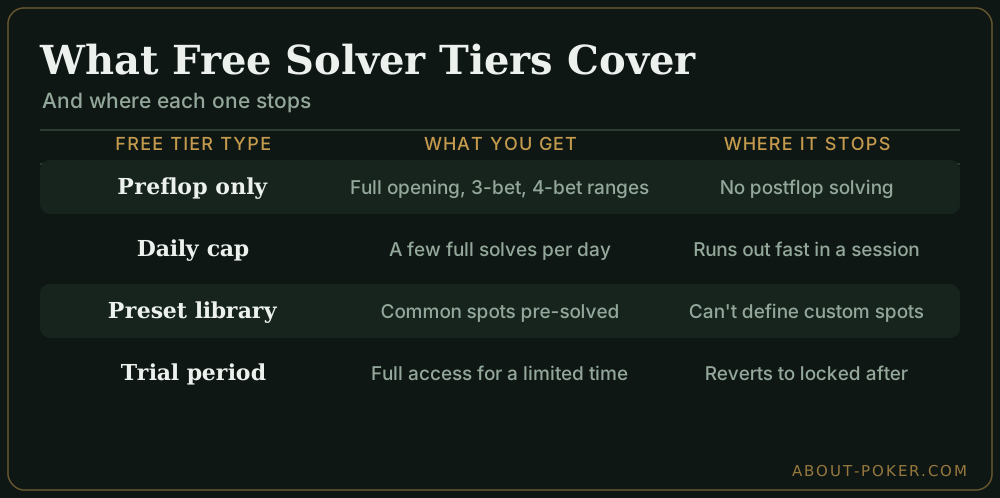
Free tiers fall into a few recognizable shapes:
| Free tier type | What you get | Where it stops |
|---|---|---|
| Preflop only | Full opening, 3-bet, and 4-bet ranges | No postflop solving |
| Daily cap | A few full solves or lookups per day | Runs out fast in a study session |
| Preset library | Common spots pre-solved | Can’t define custom spots |
| Trial period | Full access for a limited time | Reverts to locked after it ends |
For a developing player, the preflop tier is usually the most valuable of these — a huge share of leaks live before the flop, and fixing them needs no postflop access at all.
Specific tools that are actually free
Rather than talk in the abstract, here are well-known options and what each one genuinely gives you at no cost:
| Tool | What it is | Free scope |
|---|---|---|
| TexasSolver | Open-source desktop solver (Windows/Mac/Linux) | Fully free and open-source; solves custom postflop spots locally, limited only by your RAM |
| WASM Postflop | Open-source solver that runs in the browser | Free and open-source; custom postflop solving with no install, capped by your machine’s memory |
| GTO Wizard | Hosted study platform with precomputed solutions | Free tier gives limited daily access to preset spots and drills; custom solving and heavy use are paid |
| GTO+ | Low-cost desktop solver | Not free — a one-time license, historically Windows-first — but often the cheapest paid custom solver |
The pattern is clear: if you want custom postflop solving for exactly $0, the open-source engines (TexasSolver, WASM Postflop) are the honest answer, and you pay in setup and hardware rather than dollars. The hosted free tiers (like GTO Wizard’s) are easier to start with but cap custom work behind a subscription. Prices and tiers change, so confirm the current terms before you commit.
Getting started for free in five minutes
The fastest zero-install path is WASM Postflop: open it in a browser, and you’re solving without an account or a download. A minimal first solve looks like this:
- Open WASM Postflop in your browser (any OS, Mac included).
- Set the two ranges — e.g. a button opener vs. a big-blind caller — using the range grid.
- Enter a flop (say, Q♥ 7♠ 2♦) and leave the default bet sizes.
- Set the accuracy target and click solve; a dry single-raised-pot flop like this converges in seconds on a typical laptop.
- Read the strategy grid — it shows how often each hand bets, checks, or folds at the current node.
If you’d rather not solve at all and just want to drill preset spots, start on GTO Wizard’s free tier instead — no setup, but you’re limited to its preset library and a daily cap. For unlimited custom spots with a heavier engine, TexasSolver is the same idea as WASM Postflop but installed locally, using your full RAM instead of the browser’s.
Reading the label before you trust it
Not everything called a “free solver” is a solving engine, and the word gets stretched. Before you lean on one, work out which of these it really is:
- A live solver with a free cap — it truly solves spots, just limited in volume.
- A precomputed lookup — instant, but only covers spots already in its library.
- A trainer — it quizzes you on solved spots rather than letting you define new ones.
All three help, but they answer different questions. If you need a specific custom spot solved and the free tool turns out to be a lookup or a trainer, no free tier will reach it — that’s a real paid use case, not a gap you can route around.
The Mac question
People search for a “free poker solver for Mac” because native desktop solvers historically favored Windows. The clean workaround is that browser-based tools run on any operating system, so a free online tier is usually the simplest route on macOS — no installers, no compatibility headaches. If you later need heavy custom solving on a Mac, that generally means a paid tool or a Windows environment, but for learning ranges the browser path is fine.
How far you can get without paying
A useful rule of thumb: stay free until you can name a specific spot the free tier won’t let you study. Until you keep hitting that exact wall, you haven’t outgrown it. In the meantime:
- Master preflop first on a free tier — it’s the highest-leverage, lowest-cost study available.
- Study a few spots deeply rather than skimming many. A daily cap quietly enforces that discipline.
- Round out the workflow with the wider free kit in our free poker study tools roundup.
- Learn the theory underneath — pot odds and equity are what make solver output mean anything.
When you can finally point to the precise spots a hosted free tier blocks, that’s the signal to move up — either to a paid subscription or to a free open-source solver like TexasSolver or WASM Postflop you run yourself. Not a moment sooner. If you’re still fuzzy on what a solver is actually computing for you, start with what a GTO solver is.
Frequently asked
Are poker solvers free?
Some are, in limited form. Hosted free tiers usually cap what you can solve — preflop only, a few spots per day, or a small preset library. But open-source solvers like TexasSolver and WASM Postflop run on your own machine and solve fully custom postflop spots for $0, because you supply the compute instead of a paid server.
Is there a free poker solver for Mac?
Browser-based tools with a free tier work on any operating system, Mac included, because they run in the browser. Native desktop solvers historically favored Windows, so on macOS a free online tier is often the simplest starting point.
Can a free solver actually help me improve?
Yes, especially early on. A free preflop tier teaches opening and three-betting ranges, which fixes a lot of leaks before postflop even matters. You upgrade only when your study clearly outgrows what the free tier covers.