Playing the Final Two Tables
How to play the final two tables of an MTT: exploit soft final-table redraw pressure, attack medium stacks, and set up a deep run before the last nine.
On this page · 6 sections
Playing the final two tables well is about recognizing that you are in a soft, high-leverage window: the field has thinned to roughly 12 to 18 players, everyone can taste the official final table, and a huge share of your opponents shift into survival mode. The winning approach is to attack that timidity relentlessly while keeping enough discipline to arrive at the last nine with chips.
This stage is often the single most profitable part of a tournament for a strong player. The money is real, the pay jumps are meaningful, and yet many opponents are playing scared. If you can read who is protecting a stack and who is genuinely dangerous, you can accumulate chips almost for free.
Why the final two tables play soft
There is a psychological milestone at the official final table. Making it means a photo, a chip count on the stream, and a bigger cash. Players who have grinded for hours do not want to bust in 11th or 12th place, so they clamp down and fold marginal hands they would happily play earlier. That collective tightening is fold equity handed to you.
The pay jumps at this point are smaller than they will be later, so the intense ICM pressure of the bubble has eased somewhat. That combination — real but modest jumps plus scared opponents — is exactly the environment where controlled aggression prints chips. You are not risking your tournament life on every hand; you are picking up blinds and antes uncontested and three-betting light against people who cannot call.
Attack the medium stacks
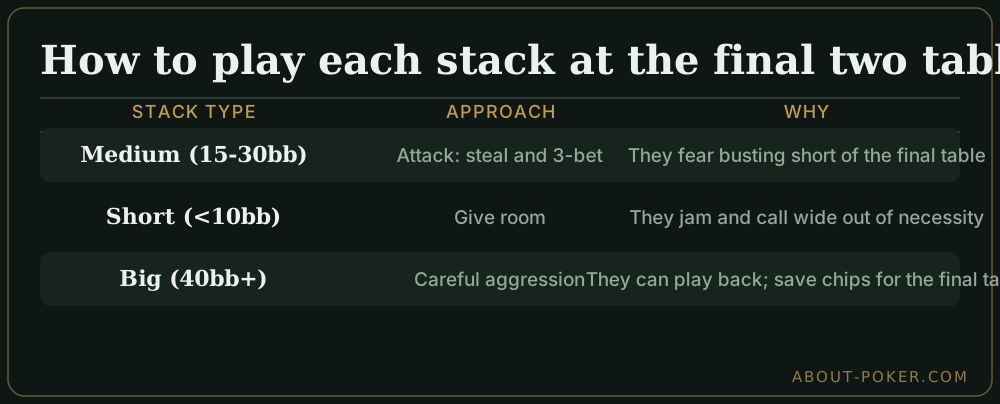
The right targets are the medium stacks, roughly 15 to 30 big blinds, who have too many chips to want to gamble but too few to feel safe. They fear both busting and dropping to a short stack. Open into them, three-bet their steals, and put them in spots where calling risks their comfortable position.
Avoid tangling needlessly with the two extremes. The genuine short stacks (under 10 big blinds) will jam wide and call your shoves lighter because they must, so give them room. The other big stacks can play back at you, so keep your light aggression aimed at the middle. This is the same logic that governs laddering and pay jumps: apply maximum pressure where fear is highest.
A worked example
You have 42 big blinds on the button, second in chips at your table. Action folds to you and the two blinds are a 22 big blind player and an 18 big blind player, both of whom have folded to steals repeatedly this orbit. You raise to 2.2 big blinds with Q9 offsuit.
This is a clear steal. Neither blind wants to flat out of position and play a big pot with a middling stack this close to the final table, and neither wants to jam 18 to 22 blinds into the table chip leader and risk busting in 13th. Your actual cards barely matter. If the 22 big blind stack does three-bet jam, you fold and lose 2.2 blinds; if they call, you have position and a hand that can flop something. Roughly seven times out of ten you simply take the blinds and antes, and that adds up fast across an orbit.
Build a stack that matters at the final table
Chips accumulated here are worth more than the same chips later because you carry them into the phase where pay jumps explode. Arriving at the final table with 50 big blinds instead of 20 changes everything: you get to be the bully described in the final table strategy guide rather than the one being pressured.
That said, do not confuse aggression with recklessness. Building a stack means winning uncontested pots and dominating spots, not calling off 40 big blinds in a coinflip when better opportunities are one hand away. The best players grow through low-variance steals and well-timed three-bets, not hero flips.
Track the other table
You are trying to reach the same final table as the other table, so their stacks affect your decisions. If the other table has two sub-eight-big-blind players who look ready to clash, you can briefly tighten, let them collide, and ladder up while risking nothing. Once the short stacks resolve, go back to attacking.
Awareness also tells you what the final table will look like. If the other table is full of big stacks, the last nine will play more aggressively and you want more ammunition. If it is short-stack heavy, survival will be worth more and you can lean on that.
Checklist for the final two tables
- Identify the medium stacks playing to reach the final table and target them with steals and three-bets.
- Give the desperate short stacks room; do not spew into the players who must gamble.
- Prioritize low-variance chip accumulation over hero flips.
- Watch the other table’s short stacks so you can ladder for free when they are about to clash.
- Remember chips here convert into final-table leverage, where the real money lives.
Frequently asked
How is the final two tables different from the final table?
The pay jumps are smaller but the field is still large enough that many players tighten up to reach the official final table. That fear creates fold equity you can attack, especially against medium stacks who want to redraw at the last nine rather than bust in 12th.
Should I gamble to build a stack before the final table?
Selectively. A big stack entering the final table is worth far more than an average one because the pay jumps steepen there. But do not spew off a healthy stack on marginal flips when clean, high-fold-equity steals are available against players playing to survive.
Do I need to track other tables?
Yes. Watch the short stacks at the other table. If two of them are about to clash, you can tighten briefly and ladder for free, then resume attacking once the count is back to normal.